Showing posts with label running. Show all posts

Wednesday, July 15, 2015

Gear Review: Newton Kismet

Newton Kismet in the color I've been testing. Image courtesy of Newton Running.
It's been almost a year since my last product review, which was the Skechers GoRun Speed. In the time since, I've had the unfortunate experience of #OopsIBrokeMySpine and the long road to recovery coming back.

As part of that recovery, it was also peak time for a new pair of shoes. My good friend Seth had opened up Granite City Running this past winter. As part of his opening, he had Newton Running come to the event with some demo pair of footwear. After chatting with their rep, as well as Seth talking up the Kismet, I decided to try a pair on.

I immediately knew that I was going to need to take a pair for a long-term test. I bought the orange pair that you see above in April from GCR and have been piling on the miles in it over the last two months.

The Tech Babble
The Kismet was a new model for Newton during 2014, as part of the year-long switch from the original four-lug platform to the new five-lug shoes. Part of this was due to advances in manufacturing tolerances; Newton had always wanted to be able to do five-lugs, but couldn't ensure the quality of the manufacturing to ensure the lugs would actually stay on the shoe when they were pushed out to the edges of the outsole.

In the image above, you have an old Newton Distance S; underneath, a Newton Tri Racer. As you can see, the five-lug pattern pushes out to the lateral edges of the midsole, whereas the old four-lug placement required a decent amount of offset from the edges.

The Kismet is part of the "P.O.P 2" family in the Newton line. Newton divides the line-up into the three distinct ranges:
  • P.O.P. 1: These are the classic shoes in the Newton family: the Gravity, Distance, and Motion ranges. They feature the lowest drops, most exposed lugs, and the classic Newton responsive ride.
  • P.O.P. 2: Referred to as the "Core" models, these shoes have a slightly higher drop than the P.O.P. 1 shoes. The lug pattern is also slightly less obtrusive, while also featuring slightly more cushioning than some of the P.O.P. 1 shoes.
  • P.O.P. 3: The most "traditional" of all Newtons, the lugs barely protrude from the outsole. These are designed to get people used to the feel of a Newton before transitioning into one of the other two families of shoes.
Now, I hear your question: why should I care about the lugs?

It's not so much the lugs that you should be worried about, it is the membrane that the compress into. This Action/Reaction membrane is compressed upon impact and then provides energy return. This is what gives Newton their snappy feel and has led to the claims from runners that they simply run faster in a pair of Newton's than anything else.

The Kismet is Newton's stability shoe in the P.O.P. 2 line. Newton takes a non-traditional approach to stability these days; rather than putting in a medial post to try to slow the rate of pronation, Newton fills out the shoe under the midfoot for maximum ground contact. This creates a more stable platform for the entirety of the foot to land on. Newton found during development that this approach provided a more stable and natural experience for runners with higher pronation rates.

The Kismet weighs in at 9.7 ounces in a size 9, with a 4.5 mm drop. Naturally, I have to take these published weights with the whole shaker of salt in my size 13 boats.

The Run
Running at Ragnar! Photo Credit to Kelly.

One of the primary things I noted when I slid my foot into the demo pair of Kismets back in December was what I didn't notice:

  • No annoying overlays in the wrong place.
  • No obtrusive feeling out of the lugs.
  • No feeling the shoe; it simply felt like an extension of my foot.
In other words: damn, this shoe feels like it fits my foot really, really well.

I've put about 200 miles on the shoe thus far and can say that, for the most part, those initial feelings continue to hold true. Unfortunately, the Newton logo attachment on the medial side, coupled with an overlay, tends to bunch up a little bit on the side of the foot over time; I've blistered a few times over in this spot.

That said, though, the ride of the shoe has been a revelation. I had a pair of the original Newton Motions, which I found the lugs to be overly obtrusive and the ride too harsh for long runs. Newton has finally found the feel balance: well cushioned yet responsive enough that you really feel the snappiness of the shoe when you pick up the pace.

A note: be prepared for the shoe to sound a little slappy, especially on some downhills. Don't be alarmed; it's just the AR membrane compressing in the heel. It took me a minute to figure out what the sound was, but it has not impacted overall performance of the shoe at all.

The beauty of this shoe is that it is light enough to race long distances in, while still retaining the cushioning and feel of an everyday trainer. It is an excellent swiss-army knife to add to your running arsenal, assuming that you need that touch of stability on offer here.

$129.00
Available Now


Wednesday, November 5, 2014

Service Available: Triathlon Bike and Run Shoe Recommendations

In the market for a new bike, but don't know what will fit you? Fell in love with an old running shoe that was discontinued five years ago and are still struggling to find that new shoe that you love? You've come to the right place.

Let's get the obvious out of the way: here's what I don't do:

  • I won't attempt to re-fit you on the bike. Instead, we will be trying to find the most optimal bike to work with your current position (or slight variations of it). This theory will also not guarantee one single bike to be best; instead, there will be a range of options presented to you based on price range and flexibility of the bike to evolve with your fit.
  • I won't be doing run assessments. I have a doctorate degree, but it is not in the medical field, and therefore it isn't my job to tell you how to run. I want you to just be able to run, and to enjoy every stride while you're out pounding the pavement.
Here's what I will do:

  • Provide detailed recommendations of bikes and shoes to try, along with respective sizes.
  • Provide feedback on local shops to you to be able to purchase these items from.
  • Analyze Retul, Guru, etc. fit files, as well as photos on board of the bike to analyze potential positional errors as well as providing additional feedback on these recommendations.
  • If preferred, Skype consultation to talk about the analysis and feedback.
About Me:

  • A decade of experience in the specialty run and triathlon marketplace, working at multiple Top 50 Running Stores in America (presented by Competitor) as well as with Revolution3 Triathlon
  • Good Form Running certified
  • Worked with dozens of medical practitioners to provide best shoe fit for their clients
  • Self-proclaimed repository of useless information, shoe geek, and athlete
  • Comprehensive knowledge of FIST-method of triathlon bike fitting and how frames and component choices complement one another to provide the best overall fit for a consumer
  • Hundreds of success stories from customers in the run and bike marketplace (such as this):

Pricing for these services:

  • $40 for bike recommendations
  • $20 for shoe recommendations
  • $50 for both
Contact me via e-mail here to set up your consultation.

Saturday, September 6, 2014

Shoe Review: Skechers Performance Division GoMeb Speed 2

Editor's Note: I received this pair of shoes from Skechers Performance Division for the purposes of review. I was instructed to be honest. No financial considerations were offered nor would they ever be accepted.

I think I speak for a lot of people in terms of my initial reaction to Skechers launching a running shoe product line:

Skechers? REALLY? The folks who put out Shape Ups? Are you kidding me?

Yep. That was my initial attitude in the summer of 2012 as I saw the product line for the first time. I was seeded (read as: given a free pair of shoes; it is a common thing for a brand to do in the industry as hey, if you don't believe in it, you won't sell it) a pair of the GoRun Ride's.

And what do you know, they are actually pretty comfortable. Not great for me (a little too spongy underfoot, not quite moving with my foot) but a hell of a lot better than a lot of other things on the wall.

Fast forward to April of this year, and getting to see the big marketing push as Skechers segmented out the running shoe line in the new Skechers Performance Division at the Boston Marathon.

And then Meb won.

Then they signed Kara Goucher.

It was a sign of a brand that said, "We are committed to performance. We are committed to running." And now, starting in the spring, shoes will be exclusively committed to the specialty running channel. That's more than a lot of "traditional running brands" can say.

So with that in mind, I took a look at the product line, and asked if I could take the GoMeb Speed out for some testing. I figured it would be the ultimate test for the brand. At the end of the day, product is king. If your product sucks, it doesn't matter what elites are running in your shoes or how much you're trying to do for the industry. Your product better damn well be good.

The Tech Babble
Skechers Performance Division (think like the old Bowerman line in Nike running shoes; if it's not Skechers Performance Division or Bowerman in Nike-speak, odds are you're not looking at technical running product) started out introducing a line-up based on "M-Strike Technology." The "natural running" movement had really taken off, with the Saucony Kinvara, the Brooks PureProject, and New Balance Minimus product line really moving.

That being said, SPD took the tack of trying to offer more than just a "minimal" shoe. They would offer more of a range than simply going after the lightweight/minimal end of the market.

There are multiple shoes in the product line; this is their order from least to most cushioning: the GoMeb Speed, the GoRun Bionic, the GoRun, the GoRun Ride, and the GoRun Ultra. There will be more shoes launched throughout. They also range in offset from 0 to 8 millimeters.

The focus of this test, the Speed, features a 4 millimeter offset. This is similar to one of my favorite flats, the Saucony Fastwitch. The Speed features a mid foot shank of Hytrel, which gives the shoe some beef under the mid foot. A lot of times in racing shoes, the flexibility results in a shoe that gives up platform stability and efficiency. In theory, this is not the case here.

SPD, much like Pearl Izumi, does not use a "secondary" cushioning system like Air, Gel, or DNA. Instead, they rely on their blend of foam. In this case, SPD calls theirs Resalyte. Resalyte is an injection-molded compound, which according to SPD provides "memory retention [to] help absorb impacts." The beauty of foams, like the one SPD uses, is that each brand can spec different durometers, different air volume in the compound matrix, etc. that provides a unique ride.

The upper is seamless on the inner, with most overlays either printed or heat-molded onto the shoe. This in theory reduces the chances of blistering, as there are fewer places for the foot to really rub against a firm section on the interior. I wound up wearing the black-and-gold edition seen above.

The Speed weighs in at 6.8 ounces in a men's size 9. To put that in perspective, it's .9 ounces lighter than a comparable Saucony Kinvara. Versus my go-to flat, the Saucony Fastwitch, it is .1 ounces lighter. As an aside, the Speed ran large, and so I wore a 12.5. This will not give a true comparison on weight to a Fastwitch, as I wear a 13 in it, so I won't try to argue the merits. Besides, it's .1 ounces. I would never be able to tell the difference.

Enough Babble. How was the run?
In a word: brilliant.

I received these shoes on a Wednesday. That following weekend, I went down to Connecticut to tackle the Revolution at Rev3 Quassy, where I would be racing an Olympic on Saturday and a Half on Sunday.

I had made the decision that Saturday was my "race" day. My Fastwitch's were somewhere in my storage unit (I had just moved back from VA to ME), and I figured what better way to give a shoe a test than to slap 'em on and go racin'.

You put the shoe on and immediately notice...nothing. This is the best compliment you can give a shoe, in my opinion. The last thing you ever want to do when running is be worried about something on your feet. I slipped them on and just felt like the shoe and my foot were united in their job to propel me from Point A to Point B as quickly as my body could go.

Starting to stride, the shoe has a very snappy feel to it. You're going from impact to toe-off in a smooth, quick fashion. It wants to get up and play. That being said, it is incredibly well-cushioned. It felt as soft as some of my daily trainers in a much, much lighter package.

The mid foot shank works. As I started to fatigue, I could feel the shoe helping provide a stable platform for my foot to land on. It's secure and just lets you focus on turnover, breathing, and nutrition. In other words, again: you're not thinking about the shoe on your foot.

I crossed the finish line Saturday and faced a dilemma: the Speed felt so damn good, would I wear it again tomorrow on thrashed legs? For a half?

Answer: yes, yes I did.

And what do you know, it felt even better than the day before. The cushioning is incredible for a lightweight flat. It's the fastest I've ever run the half course at Quassy, and I can honestly say I ran every step of that run course for the first time. The shoe helped. It just let me go.

Would I wear this for a marathon? I was scheduled to find out the day that I broke my spine. I would guess that it would be close for me, personally, especially coming off the bike. But I can't honestly answer that question yet.

In sum, this shoe supplanted the Fastwitch as my go-to race flat. Of all of the things I'm looking forward to in my recovery, slapping these bad boys on for another race is towards the top of the list.

Skechers Performance Division GoMeb Speed 2
MSRP: $114.99
Available: Now

Monday, January 20, 2014

Time Bomb: Charleston Marathon Race Report

I *ahem* have a bit of a reputation for blowing up spectacularly in races. If you've been around these parts, you've seen it in the following events: Timberman 70.3 in 2011; Boston Marathon, Rev3 Maine, Rev3 Cedar Point in 2012; the Mid-Winter Classic, Rev3 Quassy (well, different story, but still), and Rev3 Cedar Point in 2013.

That's a lot of races.

Now, many of these were of my own volition. Outside of Boston, the 2011-2012 campaigns were me being an idiot on the bike and faltering on the run as I deserved. Race like a moron, suffer like a moron.

As for 2013: well, the Mid-Winter Classic featured my left calf seizing at the 7 mile mark and gutting it out to the end. Quassy had my infamous vasovagal response. And Cedar Point was a combo of pre-race exhaustion, stress, and nutrition error, coupled with probably being undertrained.

So, piling all that together, we've been working on a lot of different things: work on the nutrition front and discovering some intolerances; a new coach that has been extremely beneficial; a renewed focus on the process and taking joys in the daily training and not just the focus on the race itself. It's been extremely rewarding so far.

When starting to work with John, he wanted to put an early marathon on the calendar. Outside of Boston 2012 (news flash: it was hot as hell), I hadn't raced a marathon. So really, this would be my first serious crack at the distance and really relished the opportunity to set out a new run PR.

Training went well. I had two hiccups along the way. The first was during my elimination diet with Christine: I got incredibly sick as all of the processed foods and caffeine was cut out of my diet. Crushing migraine, fever, you name it, I had it. Knocked me out for a 4 day stretch in November. But I managed to hit all my workouts from there on out, so I felt comfortable with the amount of training.

The second was a little more worrisome. My left Achilles' had started to act up during one of my weekend long runs in December. I took it easy with it and it seemed to calm itself down. However, in my second-to-last long run, that calf/Achilles seized on up at the 14.5 mile mark. I shut that run down and focused on stretching, rolling, massaging, and otherwise keeping that as happy and as loose as I could. The next week was my last hard week, where everything felt decent again. Crisis averted, I thought.

Taper was a good hard cutdown. It felt really good to recover, do some relaxing, and otherwise bounce back from all of the mileage. Based upon the 800 prediction workout, I was in about 3:05-3:07 shape. I thought that it'd be smarter to go a little more conservative and look for 3:10-3:15 out of the race.

And then it was here: go time. We drove down on Friday to Charleston, about 7.5 hours if you don't stop or 8.5 when you have the dog with you. We brought Dylan along and he was a champ.

Saturday AM: wake up. Coffee. Had a scone. Headed over to the race site; holy crap, this race is bigger than I thought. 5000 of us idiots between the half and the full. Good times.

And soon it was time to get into the starting chute. I opted to line-up with the 3:15 pace group. There was no pace group faster than this. Also, I figured it'd be smarter to run conservatively to start off with and then pick up the pace at the end, rather than be all "bank time up front." There's no such thing.

No real warning given; just a "30 seconds to go" mark. Oh, OK, guess I should get nervous now.

Air horn, and away we go.

Everyone takes off. Sizing people up pretty quickly, you get a decent idea as to who is blowing up their 13.1 and 26.2 mile journeys in the first mile. There are some people who are blowing your doors off, huffing. Then there are others who are also blowing your doors off while having a complete conversation about how sick they were earlier in the week, and how they just want to "jog it in under 3 hours." I hate those guys.

Anyways, the first couple of miles along the waterfront are gorgeous. I felt myself very relaxed, just cruising along, ticking off miles between 7:08 and 7:15. Not focused on pace, but instead on the effort. I want this to feel a little too easy, like I have a lot more to give, like I'm not forcing the issue. I want to be able to really start putting the work in at mile 10. I kept reminding myself that I needed to remain conservative.

At about mile 3 we turn away from the water and into the wind. Charleston was getting a good 15-20 MPH wind out of the west to northwest. This meant this 7 mile stretch was directly into the wind. Luckily, the half and the full courses ran with one another to this point, so there was good conversation to be had and a good number of people to help break the wind and pace with.

10 Mile mark reached in 72:55. That was only 41 seconds slower than what I ran the Mid-Winter Classic in last year. But this time, I felt strong rather than stumbling my way on down to the finish. At this point I started to lift my effort ever so slightly. At this point, we split away from the half and onto an out-and-back; two miles down, two miles back. At 11 the mens leader was on his way back. So I was only two miles behind, which really gave me a lift. 12 was a nice clip as well.

Then we turned around and hey, what do you know, here's the headwind again. I look around and realize I'm three minutes up on the 3:15 group. Score! Halfway home and we're still feeling strong. One of the guys I'd been running with decided to put the afterburners on. He said he thought he'd see me again. He was wrong. We meandered our way back towards where we exited, and got a little shield from the breeze.

At 14 we re-joined the half course. It was easy to let the pace drop here, as we really came back into the headwind again and we were mixing in with the 10:00-11:00/mile half athletes. Luckily, it is a four-lane road so it wasn't too crowded. There were four of us in a row making our way through the crowd. I was determined to stick with this group as, after conferring, we were all looking to run about the same time. That and, well, the scenery wasn't so bad, either. (I apologized to Hannah later.)

Mile 16 and we're still ticking along. The half course splits away again. Eight miles up in here and I'll see this point again. Liking it.

We're about to roll towards an aid station when...

The left Achilles goes. It wasn't a pop, or a snap. But something just went right, along with the sudden increase of what felt like something warm, like a rush of blood, to the area. It slows me down immediately. But the pain isn't unbearable. It just sucks.

I take stock of the situation. Every step hurts, but it doesn't stop me. I'm finishing this race.

I hit the aid station and make sure I get some Gatorade, some water, and some of my own calories into me. And we keep running.

At 18 the 3:15 pace group makes its way past me. They're friendly, asking how everyone's holding up. I try with every ounce of my being to stay with them. At first I'm towards the front of the group. I'm grimacing but hanging tough. I start to slide backwards through them as the pain becomes a little more intense. Soon I'm barely hanging on. I'm digging so far down into the depths of pain tears start to roll out of my eyes. I'm grinding my teeth.

And I still fall backwards out of the group and the gap starts to open. I dig further. I'm tempted to scream. But it does no good. They're pulling away.

When the elastic snaps, it snaps. Try as you might, you won't quite get there.

I re-assess. We're 19 miles in. I can survive for 7.2 miles of torture. Each and every step will be a lesson of how far I'm willing to go down the rabbit hole. Give everything you have. Empty the well. Run as fast as you can for every moment.

I grind my way through the next 5 miles. I'm in no-man's-land: I'm faster than the majority of the race but been left behind by the truly fast. I get picked off by three or four people, and pass a few others that had blown up and were walking.

Mile 24 moves us onto a twisting concrete path. This is agony. I contemplate why I do these things in the first place, but immediately find the answer: to learn more about your character and your desire. And dammit, this is fun. Most of the time.

We now move off the concrete and onto a dirt path. Oh, God, my calf is gone. Just chop it off. I won't notice. It can't hurt much worse.

At 25.5 I pick up a guy who looks like he's been miserable for a while. He told me he'd gone out way too hard and has been Gallowalking the last 4 miles. We both were in an equal amount of hell. But one look to one another at that point sealed our fate: we were going to race each other to the line.

It must've been hilarious to watch, as the pace says our "racing" may have been more like crawling. But we were going to leave it all out on the course. He took the lead to start, and then I really put on the gas as we made our third-to-last turn.

I'm pretty sure you can see how miserable I am. Also, OW.
We came into town, weaved around the block, and made it. In the end, I nipped him by two seconds. Final totals: 3:28:49, 85th OA, 10th M25-29.

I crossed the line, immediately cramped on that left side, and had to grab onto the crowd fencing. Managed to work it out enough so that I could take a finisher picture. I then got an immediate ticket to the massage and PT tent, which was awesome. Got me to a point where I could actually move a little bit.

And, of course, the reward for a hard day's work:
Michelob Ultra will never taste this decent again.


Monday, December 23, 2013

I've Taken All and I've Endured...

...one day it all will fade I'm sure...
         --Foo Fighters, I'll Stick Around

My coach is trying to kill me.

Let me explain.

John has, shall we say, a very *ahem* unique method of motivation:
As many of you are aware, I'm training for the Charleston, SC Marathon in January. We stand just under 4 weeks away from me toeing the line of a race again. Crazy to think! But then again, outside of a couple of 5Ks in November and December, I haven't really attempted racing since the Cedar Point disast-debacle. So...we're due.

To give you an idea of John's ideas on training load, let me illustrate using a classic from the Paulo Sousa meme thread on Slowtwitch:

 To take you through a sample week: one recovery day. Run slow. Run trails. Run uphill. Run fast. Run long. Run long with tempo. Bike hard. Bike long. Swim somewhere in there. And oh yeah, get some core work done too.

Add on top of this that I got to spend the better part of two days with a sledgehammer and a crowbar taking out about 2500 square feet worth of engineered hardwood that was overglued to the floor (evidently, the previous tenant used the glue to LEVEL THE FLOOR)...and I'm *ahem* tired.

But it's all going to the right place. I've never run this much before healthily. I feel strong. Running is coming easier and easier. On some of these long runs, I just start jamming out 7:00 pace without really thinking about it. Of course, I then slow down when I realize what the hell I'm doing (don't leave your race in a workout).

This week, though, is the test: have a predictor run tomorrow (basically, what I can punch out for that test workout is a great indicator of marathon time/pace) and a 20-mile progression run on the weekend (get to test out that indicated pace).

Bring it, John. You haven't killed me yet.

____________________________________________________________________________
Under that same token, I've been doing a lot of work with Christine Lynch to figure out what the ruddy hell has been wrong with my stomach.

As you've probably tired of reading in this space, I've had a lot of challenges with my gut. Whether it's pre-race, during the race, post-race, cramping, vomiting, etc. I was tired of it. Plus, Christine is the one that took this phenomenal photo of me in the medical tent at Cedar Point:

So...she's seen me in some pretty bad spots before.

After some consulting, we decided that the best approach would be to follow an elimination diet for the better part of 6 weeks. What's an elimination diet, you ask? You pretty much get rid of anything and everything that could possibly be a food intolerance. So...pretty restrictive overall. You then add foods back in, one item at a time, to test how your body responds to things.

Add that on top of the training from John...and there were some days where I certainly contemplated putting my head through a wall. (There was in fact a day where I got violently ill from cutting my coffee habit off cold turkey. Worst migraine ever, fever, chills, you name it I got it.)

Well, as it turns out, I'm intolerant of soy and don't handle fructose well under training load. So, out goes soy out of the regular diet, and finding new sports nutrition that doesn't contain fructose in it. Good times. But as we've done this, we've gotten rid of almost all of the symptoms that I used to deal with. It's awesome.

Christine's also helping out on the daily diet front, trying to find some more healthy recipes, etc. that aren't simply "lay protein over massive spring mix and spinach salad, add balsamic vinaigrette (good luck finding one that doesn't have soybean oil in it!)" which, although delicious, is awfully repetitive. We're getting there.

It's been an awesome experience, getting to know what works in my system and how it responds under the volume John's putting me under. It's been, dare we say, fun. One of the biggest lessons out of all of this is enjoying the process of what works for me as an athlete, and even what doesn't work. Then taking those lessons and applying it to racing.

Still a little ways to go before that happens. Time to keep slogging onward.


Monday, May 6, 2013

Shoe Review: Pearl Izumi EM Road M3

Disclosure Note: As part of my relationship with Team Rev3 Triathlon, I receive product from Pearl Izumi. Pearl Izumi provided me with this shoe. I was not compensated for this review, nor would I accept any if offered. The opinion within is entirely my own.

Now that we've gotten the legal stuff out of the way (you see, every once in a while that J.D. from the University of Maine pays off)...

Unless you've been living under a rock for the past couple of years, you know that we've ridden a pretty crazy ride in the footwear world. Vibram FiveFingers were initially brought into the U.S. as a hiking and sailing shoe, then Born to Run storms onto the scene and everyone goes full minimal. Saucony brings out the Kinvara, and away we chase on down the rabbit hole. New brands storm onto the scene. Less shoe. Less offset. Less everything!

Good thing, right?

Eh...not so much.

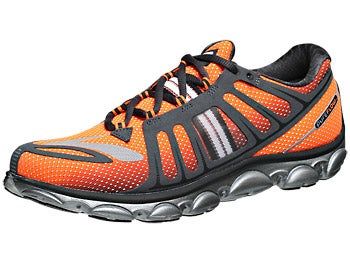
We've entered into what some have clumsily dubbed the "Post-Minimalist Era." The "natural run/minimalist" market makes up a little more than 10% of overall sales volume, and that number has stabilized since the latter half of 2011. The majority of shoes that hit into the top 5 listing there include the aforementioned Kinvara, the Brooks PureFlow and PureCadence, and Newton's Gravity. What's the trend with all of these shoes? Let's look at the PureFlow as an example:

Brooks Men's PureFlow 2. Image courtesy of Running Warehouse.
There's still an awful lot of cushioning there. To call that shoe minimal is doing it a disservice. So what's so different about it?

The body positioning is different. Most typical shoes (e.g., those not in this category) will feature a 10-12 millimeter difference between the height of the heel versus the height of the forefoot. This is referred to as either drop or offset.

So, the natural run concept marries the idea of being closer to a barefoot-esque body positioning, but paired with the knowledge that we also don't run on a surface that the human body was really designed for (asphalt and concrete, we're looking at you). The Flow, and most shoes like it, will feature somewhere between a zero drop and 4 millimeter offset.

Well then, you ask, what is right for me? Don't we all want to be more natural with the way we run?

The answer, of course, is it depends. The body is an adaptive machine; it will resort to recruitment in the positions that it is most accustomed to. In other words, your body craves the same kind of body positioning for running that you are always putting it into. So if you're always barefoot around the house and wear nothing but flats all of the time, why would we then raise you 10-12 mm in the heel to try and run? If you wear Dansko clogs all day, why would we then try to let the back of your leg extend an extra 8-12 mm when you aren't likely to have flexibility in the tissues?

But, you ask, aren't our needs throughout the gait cycle a bit more dynamic than that? We need elasticity in the back of our legs for loading, the foot then needs to become a more rigid lever for toe-off...what do we do?

And that's where Pearl Izumi comes in with Project EMotion.

Pearl Izumi EM Road M3


The TechnoBabble
(You're screaming: "WHAT? IT GETS MORE TECHNICAL THAN THAT? Not really...I think.)

As we covered above, our gait cycle is dynamic. Our feet have different needs throughout certain phases of our gait. Not to mention, of course, is that our pronation rate tolerances can be different, too. I  have a little extra navicular drop, a sign of some excess motion in the foot, but my body is relatively tolerant of it. A hint of support in the midfoot does me well.

Enter Pearl Izumi.

Pearl Izumi's been making a lot of cycling, triathlon, and running gear for years now. They've done extremely well with their cycling and triathlon gear. Their running shoes? Well, as a retailer, let me say that their previous efforts left a bit to be desired. The seamless upper has been a great innovation, but the performance underfoot did not do the rest of the shoe a service.

PI, to their credit, recognized that their shoes were not where they needed to be. So they set out to revise their entire run line-up. This isn't a cheap endeavor; you have to open new molds for all of the sizes, re-test new EVA strands, then see how they actually wind up working out.

In the process, PI started to come to the same conclusion that we'd talked about above: our needs throughout the gait cycle are different. Also, how can build a shoe that perhaps people who would normally pick between one offset or another not have to make that decision anymore? What about, instead of having to think about how they run, they can just, well, run?

EMotion works like this: the shoe's toe-spring is moved further reward, to better mimic where the metatarsals themselves line up. This allows the shoe to work with the bone structure and give a platform for that nice, rigid lever. In the rear end of the shoe, you have a slightly higher heel-to-toe offset, but based on the construction of the foam, it provides a deeper amount of compression, effectively lowering the offset. The outsole features both the EVA from the midsole (helps increase feel underfoot) along with carbon rubber for durability purposes. There's also a line running through the outsole of the shoe, showing the initial impact, pronation, mid-stance, and propulsive phases of the gait cycle. Also, all EM shoes feature a seamless upper.

Now for the sea of naming: this is easy, but confusing.

There are three main product lines: Road, Tri, and Trail. The name is then comprised of a letter and a number. The letter refers to whether the shoe is Neutral (N), Midfoot Stability (M), or Heel/Rearfoot Stability (H). The number then refers to the cushioning underfoot. 1 is least, 2 is middle ground, and 3 is ultra plush.

Currently, the line-up consists of the following options:

Road: N1, N2, N3, M3, H3
Tri: N1, N2
Trail: N1, N2, M2

Because of midfoot pronation needs, I'm wearing the Road M3. There are plans to extend out the product line with less cushioned options in Road, and also do Tri stability. That said, PI made the decision to go with where they figured sales volume would be at the start. Can't say I blame them.

The published weight of the M3 is 9.7 ounces in a men's size 9. Naturally, I'm taking that with the entire container of salt, as I'm wearing a 14 in the M3. (Please note: the shoes do tend to run on the small side! Expect to go up a half-size versus your normal run shoe size.) For comparison's sake, the published weight on the other two go-tos in my run collection right now: 8.7 ounces for the Saucony Mirage, and 9.3 ounces for the Brooks PureCadence2.

The Run
The short version: wow, Pearl Izumi connected on this one.

The long version:

You step into the shoe, and immediately notice the seamless upper. There's simply no hot spot or irritation to be found. Even though it's not the tri version of the shoe, I could fully expect someone to be able to run in this sockless.

The closest brand, IMO, in terms of the fit of the upper would be Mizuno. It's a pretty narrow overall fit, but there is some more flare to the forefoot than previously found on brands hailing from Japan. Traditionally, Mizuno and Pearl Izumi have both had very slender fits. This shoe still retains a very lean midfoot and heel, but the forefoot allows a little more splay, allowing your foot a touch more natural stability by letting your toes spread out on the interior.

Arch height underfoot is on the average side; inoffensive and unobtrusive to my foot. Those with taller arches will probably desire something a little higher underfoot, but I think for the majority that will wind up in this shoe, it's more than high enough.

Starting the run, the first thing you notice is how springy the shoe feels. Technical term, I know. But by that, I mean there's a lot of bounce coming back from the shoe. It doesn't feel like a marshmellow underfoot, but it's also not harsh. It's similar to the experience of running on a tartan track for the first time; just need a second to adjust to the bounce.

Similar to the Brooks PureCadence, this shoe is extremely versatile at a variety of paces. I took these out for some hill repeats, getting down to about 6:20/mile pace and slowing to as slow as 9:00/mile pace, and the shoe felt great during each tempo range. It firms up a little bit as you quicken the tempo, but not so much that it's punishing you for attacking the ground.

Overall, I think a lot of people are going to be very, very happy with this shoe. It's just a *hint* soft for me for my preferred 13.1 mile race-day options. This is definitely going to be in the rotation training, and will be my weapon of choice come Rev3 Cedar Point in September. Somehow, I think a little extra cushion after 114.2 miles will come in handy. At that point, it's all about accumulated load stress.

Available: Now.
Pricing: $124.99

Monday, July 9, 2012

Shoe Review: Pearl Izumi isoTransition

I've been a bad, bad product reviewer.

Two months have passed since our last gear test around the CtB offices (the SwiftWick Aspire sock review). Far, far too long.

As a make-up, though, we'll be featuring at least a product review a week for the remainder of July. There's a lot to get through: Pearl Izumi Tri Fly Carbon IVs, blueseventy Helix wetsuit, Blue Triad EX,  XPS Baking Company X-Series Cookies, as well as this review here.

So, let's get down to business, shall we?

Men's Pearl Izumi isoTransition
The Tech Babble
The first thing that generally comes to mind when you think "Pearl Izumi" is cycling, and for good reason: together with parent company Shimano, PI covers 85% of the market. To put that in perspective, the current leader in the running footwear business (Brooks) has a market share of 18%. It's a staggering number!

To no surprise, as triathlon took off Pearl Izumi went headfirst into it, creating numerous apparel and cycling shoe options. And options they have: three different product lines for apparel, three distinct options on the cycling shoe front.

However, PI's running shoes have always left something to be desired. My first experience with PI's running product line came in the form of the original SyncroSeek trail shoe. It's a shoe that makes my top 5 list of worst running shoes ever: heavy as a brick, ran a full size and a half small, and had absolutely no arch in it to speak of. It felt like PI had decided to take one of their mountain biking shoes, slapped a midsole and outsole on it, and called it good.

Not a good first impression. Hello, blacklist.

Thankfully, PI learned from these mistakes. The isoTransition still runs a little short on length, but there is an arch on the inside of the shoe, thanks to the OrthoLite insole. OrthoLite was once used by Nike and Saucony, respectively, for their insoles to their running product line.

The overall theme to the PI product line is what they call 1:1. This is, in their terms, trying to make the athlete and gear one and the same; a mating of the two that is completely natural. PI's big technology hallmark, at least for this particular shoe, is their seamless upper. There are no interior seams anywhere on the shoe. Less seams, of course, should mean less blistering, as there are fewer friction points on the interior of the shoe.

Cushioning comes from a midsole constructed solely from PI's proprietary blend of EVA. No gel pods, no Syncro cradles, no nothing extra. This is a "I'll take my meat and potatoes, thank you very much, nothing else" shoe. Don't take that as meaning that it's under-cushioned; it's just that the shoe is extremely reliant on the ability of the foam to handle the task at hand. Midsole stack heights are 19 millimeters in the heel, 10 millimeters in the forefoot, for an offset of 9 millimeters.

Drainage holes are cut through the bottom of the shoe; this has an unintended consequence which we'll get to during the running section. To complete the shoe, there is an integrated bootie tongue and elastic laces. Total weight for the shoe in a men's size 9 is 7.8 ounces; of course, my size 13 boats weigh in slightly heavier.

The Run
Well, congratulations, Pearl Izumi: you're off my blacklist.

Popping these on, the first thing you notice is, much like the K-Swiss Kwicky Blade Light, is what's not there, rather than what is: there's no impinging seams. There's no pressure points. Instead, you have a shoe that hugs around the foot before opening into a wider toebox to promote forefoot splay. It's comfortable in the same way that, say, walking around in a slide sandal is comfortable: there's only one piece really holding onto your foot, and then the rest of your foot may do as it pleases.

The isoTransition is a neutral shoe, which usually would be bad news for this esteemed author. However, there's some natural stability built in here. Some of that comes from the lowered offset and the natural splay of the forefoot (the wider your toes may spread, the larger the "tripod" your foot can become and be naturally stable). But it also comes from a relatively rigid midfoot region. A small bridge exists only on the medial side of the shoe, giving it additional structure here. It's just enough to allow me to run in it without any type of additional support. I think the best corollary might be some of your structured neutral shoes, a la Asics Nimbus: even though it's neutral, there's just a touch of stability available to those who need it.

There's some serious cushioning underfoot, especially for something with only 10 millimeters of cushioning in the forefoot. The foam has some bounce to it; I'm guessing there's a bit more rubber in the blend of EVA that Pearl Izumi engineered. But the energy return does not come at the cost of pure protection from the road. This is, in my opinion, the result of the drainage holes cut underfoot: it allows the shoe a little bit more room to spread out upon impact, dispersing energy away from the foot.

These holes also make the shoe incredibly flexible in the forefoot. This is good for someone like myself, who has an inherent lack of flexibility in my big toe: I have a hard time with shoes that are very stiff in the forefoot and getting them to respond in sync with my foot. This, on the other hand, is very easy to pick up and go.

Varying stride lengths, it seems like this is a shoe that wants a pretty high cadence. Unsurprising, given some of the athlete's that Pearl Izumi has on the roster: Tim DeBoom and Cait Snow both run with very, very high cadences. Quick turnover really makes this shoe come alive with it's mix of cushioning and energy return.

I have yet to test the drainage on the shoe, as I haven't raced in them yet and that's generally the only time you'll see me dumping gallons of water over my head. But I believe it's safe to say that it will be pretty effective, given that there is drainage from heel to toe.

Overall, it's a great riding shoe for those who like a bit more of a responsive feel underfoot, but don't want to be penalized for doing so. It's a nice mix of road feel, isolation, and fit.

It's more than a triathlon shoe: it's a great running shoe.

Friday, May 11, 2012

Gear Review: Swiftwick Aspire Zero Socks

My feet are finicky.

No, seriously: I have some serious issues when it comes to footwear. I think it's partially due to working in the running business: I'm almost hyper-aware of anything when it comes to things that go on board.

This is particularly true with socks. I've had very limited success with most running socks. Whether it's a tighter or looser fitting brand, or an acrylic versus merino wool sock, or single-layer to double-layer variety, it's been an issue to be comfortable. I'd pretty much relegated myself to the fact that no matter what I have on my feet, I'll probably have a blister somewhere while running.

And that brings us to Swiftwick socks, and my experience with them.

The TechnoBabble
Swiftwick is an interesting company in the performance apparel industry. By that, I mean that 100% of the work for their products is done in the United States. To wit, they put it pretty bluntly on their website:

We decided to make all our products in the USA. Not some. Not most. All.
If you are a proponent of "Buying Local" or "Buying in the US," well, I'd argue you can't do much better than that.

Swiftwick's socks feature 200 needle stitching. What does that mean? Well, it's the highest density that you can get into a performance sock. This gives you an extremely tight-woven pattern to the sock. This, Swiftwick claims, will prevent debris from penetrating through the sock layer and creating a friction point that could, coupled with moisture, cause a blister.

This stitching also gives an extremely tight, almost second-skin feeling to their socks. The closer something is to the body, the better job it can do at moving moisture away. But also, this will prevent the sock from potentially bunching and generating friction in that manner. Less friction and less moisture means less blistering for feet.

Swiftwick uses both acrylics and merino wool for their socks. Acrylic socks feature, generally, a 75% to 25% ratio of water soluble and water proof materials. This allows the sock to gather moisture off of your foot, and then expel it into the moisture-management system of your shoe. Acrylics also provide the elasticity to wrap the foot well and create seams that you can barely feel. Merino wool, on the other hand, is a natural thermal regulator, attempting to keep your body temperature constant. Merino is also naturally anti-microbial (less bacteria, less stink!), and can move moisture while it's still a vapor.

Swiftwick has an extremely extensive product line. Your personal preference on material thickness and tightness will determine which of their line you would prefer. The Aspire tested here is their tightest fitting and thinnest sock; the Vibe is slightly thicker and looser (and far more colorful); the Pursuit is their merino wool product line; and the Performance is their original sock. Swiftwick also manufactures custom compression lines with their Vision product line. (Yes, this is the brand with the awesome argyle compression socks.)

Each product line also has a couple of different heights to the sock, denoted as Zero, One, Two, Four, Seven, and Twelve (referring to the length of the sock above the ankle). The Zero here is the lowest sock of the line.

Swiftwick Aspire Zero (image courtesy of Swiftwick)

The Run: How do they work?
How can I put this without it seeming a little, well, over-the-top...

They're, simply put, amazing.


The first thing you notice when you receive a pair of Swiftwick's is how small they look. I took a look at the sock, and then my foot, and went: uh-oh, did I get the wrong size? Fear not. There's so much elasticity to the sock that it gets on quite well.

Once you get the sock on, it's immediately noticeable how that 200 needle stitching worked out. These are extremely plush, wrapping the foot in a pillowy-soft material. Generally, this would lead to a pretty loose-fitting sock on the foot. But instead, these sit exactly true and contour to your foot. There's no gaps of material between your foot and the sock; it just seats true.

Out on the run, it's more of the same. The elasticity of the sock still allows your foot to properly splay out, unlike some other tighter-fitting sock vendors. There's a plushness that eliminates any seaming issue from the interior of the shoe; it makes up for a deficient interior of a shoe. Shoes that I have traditionally always blistered in? Nothing with the Swiftwick's.

The true test? This is the sock I ran Boston in. I ran in a pair of shoes that, traditionally, I'd always get a blister just forward of the arch on my left foot, especially if there was some extra moisture involved. Well, there was PLENTY of extra water kicking around, given the approximate 8 gallons of water that I dumped over my head during the course of getting from Hopkinton to Boston.

When I got to Copley Square and meet up with my family post-race, I kicked off my shoes and socks to get ready for my favorite post-race shoe: Birkenstock Arizonas. I had figured that, with the amount of pain in my legs, that I'd simply ignored any issues with my feet. After all, with that much water, something had to have been wrong with a blister, or something.

I inspected my feet closely, and was absolutely astounded:

No blisters. Not one. NOTHING.

Whoa.

The only tip from a purchasing standpoint: just ensure that whatever height you purchase will come above the heel collar of the shoe. This wasn't a problem with my Aspire Zeros and the particular pair of shoes that I ran Boston in, but it could be depending on your shoe. I'll be keeping a mix of Zeros, Ones, and Twos kicking around, just to make sure I have a pair that can be worn with any of my running shoes.

All my other run socks? Relegated to work sock status. I'm never going back. Well done, Swiftwick.

Tuesday, March 29, 2011

Make Some Memories

Bonus points to anybody who can figure out the artist and song that was the inspiration for the title of this post...

It's great to go out for a run to pull data. I've written two posts about it in this space. It's refreshing to be able to keep track of your training, and be able to see how you improve through the process.

But those aren't the runs you remember.

No, the runs that stick in your head are the ones where something happened. Where you broke through a wall, or where you caught a glimpse of yourself reflecting off the glass of a still lake. That's what stays with you. Those are the moments you pull out of your well in order to get the motivation to head back out the door.

With that in mind, here's a couple of my favorite runs:

When: May 25, 2008
Where: Boston, MA
What: Boston's Run to Remember Half Marathon
This was PUNISHING. I had signed up for this race with the intention of training seriously for it. Well, a week before the race, and I had put myself in semi-decent cardiovascular shape, but my running was still garbage.

Time to man up, I thought. So I did a few hill workouts, and even ran with a backpack full of gear through near 95 degree heat. Looking back, this is probably not within the top 5 smartest ideas I've had...but I was 22. (So young and full of piss and vinegar.)

Sunday came, and off I went. I held pace to run a 1:45 until mile 7, when the cramping finally kicked in. I tried gels, Gatorade, water, stretching. No dice. I'd stretch my quad, and my hamstring seized. A stretched my hamstring, and the quad went. On this went until the finish line. But I made it, and I ran through the line. That's all I could ask for.

Why I remember it: For two reasons: the misery that I was in, yet I still pushed myself to finish. If I can do it on less than a week of training, I can finish anything. That, and to remind myself that you need to put the work effort in to be able to compete seriously.


When: February 2, 2011
Where: Portland, ME
What: 60 Minute Training Run
As you can tell, this was a quite recent event for me. It was the start of my training for Rev3 Quassy, and it was the first "longish" run that I had to pull off.

Mother Nature, it seemed, would have other plans, and it snowed. And it snowed. And it snowed. It was full on blizzard time here in Maine. School? Closed. Work? Don't think about it. So I did what every rational man would do in this situation.

Time to run.

I like running through snowstorms. There's a few different reasons for this. The first, obviously, is the fact that snow is a bit softer to run on than pavement. This makes the landings a little less jarring, and forces good form on you. The second is that nobody is out on the roads as well, so you have plenty room to run on the roads.

Lastly, it makes for an epic ice beard:
Why I remember it: There's nothing more gorgeous than a city gone completely silent, outside of the sound of your feet on the ground directly underneath you, and the occasional gust of wind. Plus, if you can run through a blizzard...you can run through ANYTHING.


When: March 27, 2011
Where: Glen, NH to North Conway, NH
What: Transition Run
First, a note: this wasn't the run that it was supposed to be.

This was supposed to be a stand-alone run, 90 minutes, cruising along here in Portland. But life being what it is, I had done a whole lot of nothing in terms of training for the week. And I was run down. Soul drained. Nothing left in the tank.

So my lovely wife, being the smart one that she is, proposed that we go to New Hampshire for the weekend. Celebrate with the family for a bit. Just get away.

Well, fine. We'll go.

Smart lady.

We started the day off skiing at Attitash Mountain in Glen, NH. Hero snow. Gorgeous day. Blue skies. Warm temps. Groomers, bumps, Volkswagens, even in the park: good times to be had all over the place. We skied till about 1:45, and then I strapped on the ole Kinvaras, switched out the snow pants, and threw on the Brooks Nightlife Jacket.

Time to run.

I started off with a quick cadence, trying to fight my way uphill, before settling into a groove. No watch, no heart rate monitor, no pace read out. This was a run about testing your mind. Current Ironman World Champion Chris McCormack just wrote about how this can gauge how close to peak you are: the better you gauge time and effort without a watch, the closer you are.

I meandered my way up Route 302, then tacked onto Route 16A to get away from some traffic. It rolled a fair bit, roughly equivalent to the course I'll be seeing in Connecticut in 8 weeks.

I got down to the end of Route 16A, where I should've made my turn to head to my finish, when instead this sight greeted me:

I ran an extra bit down to the scenic vista, just to make sure I painted that picture on the canvas that is my brain, before turning and wrapping that run on up with a hellacious climb.

I figured it'd take me about 70 minutes in all. It took me 65. Not bad for an internal clock, eh?

Why I remember it: It's the prettiest run I've ever been on. I can't describe the euphoria that hit home when I rounded that corner, but I still get goosebumps thinking about it.


So what are your favorites? Or, if you have none, time to get out there and start making them.

Thursday, December 16, 2010

Natural Running, Volume I

The hot topic in the running industry, at least for the past year or so, has been what to make of the "natural running" movement. You can point to two specific triggers, at least in the New England markets: the sales success of Born to Run, and an editorial in the Boston Globe Sunday Magazine asking, "What ruins running? Your body, or your shoes?"

Both advocate running barefoot, under the theory that it will force you to run in a specific style that will reduce your running injuries. They all point to a Harvard study that says running barefoot reduces sudden transient forces that occur during heel-striking. Sales of Vibram's Five Fingers exploded. You've probably seen at least a few people in them.

Sounds great, right? So why aren't we all running around barefoot?

Because the theory is wrong.

Here's the rub: that Harvard study I linked to? It does NOT say that barefoot running reduces impact forces. It says that it reduces sudden transient forces. What's that mean? It means the force generated by initial heel impact, transitioning through the gait cycle, which can be an extremely jarring experience, especially if you are aggressive with a heel strike. Well, there's none of that when you are running with a proper "barefoot" stride.

As for a barefoot stride: well, that's dependent on the runner. This leads me to point #2: running barefoot will not change your technique while running alone. Your feet are very, very dumb objects. They have to be told what to do. You alone control their action. This means that you have to be acutely aware of what your body is telling you: does something hurt? Then change it! This is what people mean when they say running barefoot changes their technique. The catch is, you have to be paying attention enough to listen to what your body is telling you. Without that, you'll be happily heel striking your way to a stress fracture, plantar fasciitis, etc.

Now, there's also a difference between barefoot running, and what I call natural running. Let's go with a simple fact: the human body was never designed to be on concrete or asphalt. We were meant for dirt and grass. Think about how you feel sometimes when running on pavement, versus running on trails. Feels softer, right? That's because the Earth was protecting you, absorbing some of the impact itself rather than you having to do all of the work.

If you're reading this blog, you're probably a road runner. So, what's a road runner to do with all of this information? Here's my position on natural running:

  1. If you are injury-free, and have not had problems, do not change a thing. Why try and mess with something that's working? If you are having success with your current running technique, don't add a different variable to the situation. Go with it!
  2. Recognize that natural running may not be for you. There are some foot-types that just flat-out are not going to work. Severe overpronators wearing the Brooks Beast, I'm looking at you.
  3. Barefoot work is a good thing. After reading the above, you're probably thinking I'm totally against going barefoot. That's not the case. I think the strongest point to be taken from this movement is to do a little light barefoot work, on softer surfaces, to help promote your form. Pay attention to what your body is telling you. If something hurts, you need to be changing something! I like to do my barefoot work as a recovery workout. I'm more aware of what my body is telling me when it's a little beat up, and recovery workouts are meant to be run slowly to begin with!
  4. Take this stride to your shoes. Again, your feet are dumb things. Shoes are dumber! They are inanimate objects. They can't tell your feet how to land. You tell your feet how to land. So, after doing some light barefoot work (I recommend once/twice a week, depending on your run volume, and usually no more than a 5K), try and take that stride to your running shoe, which was designed for roads, etc.
Now, what kind of shoe should you be in? That'll be my next post: minimal versus natural versus road shoes. As a teaser: results will vary, depending on body-type, running technique, and personal preferences.