Showing posts with label triathlon. Show all posts

Wednesday, July 1, 2015

The Return: Challenge Atlantic City 70.3+ Race Report

June 28, 2015 at 6:30 AM. 328 Days, 22 Hours, 14 minutes and 40 seconds.

Brackett stabilizing my neck as the EMTs arrived.


It's been that long since I went from laying in the road in North Berwick with a broken spine to gun time at Challenge Atlantic City, diving into the water to start a 70 plus mile journey back into competing.

Racking the CD0.1.


Months of physical therapy. Months of "actual" therapy with a set of trauma specialists. And a long road back to being something closely resembling an athlete. All coming down to finally just saying, "let's throw caution to the wind and go for it." No better time than the present to toe the line.

Pre-Race
Drove down on Saturday morning with Kelly and arrived in town to a very wet and windy Atlantic City. It was my first time to AC; I was slightly overwhelmed by the mix of Cape Cod beach resort town, casino central, and parking fees that rival downtown New York City.

We grabbed breakfast at a little diner that had excellent pancakes and then rolled over to the expo inside Bally's. It was a bit disorienting to walk through a casino at noon to see the crowd there, as well as the numerous athletes streaming in and out who were trying to prep for the following day's events.

Saw some of the old Rev3 crew working their tails off as always, and then found this waiting for me:
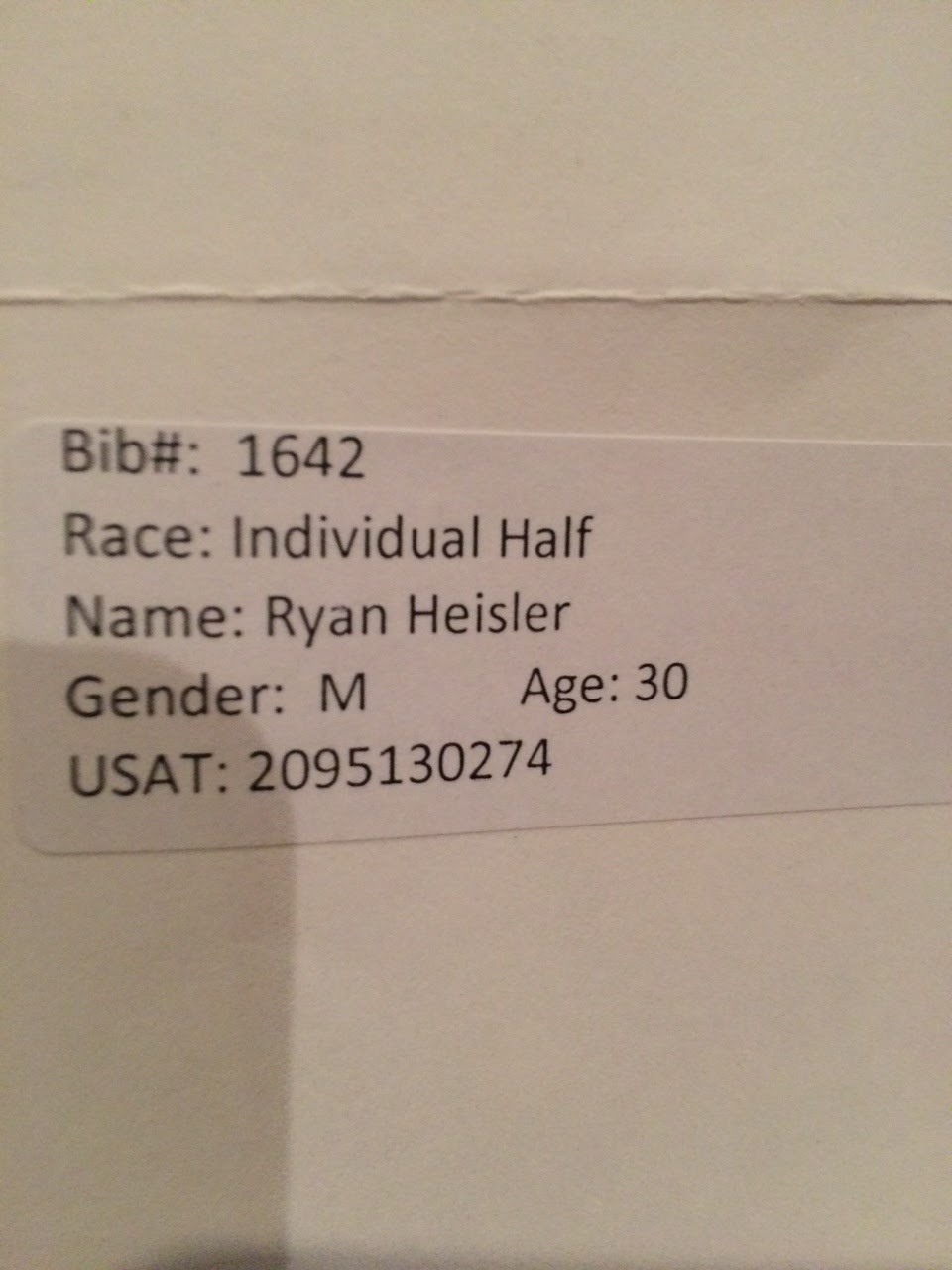
First: I'm a bit perturbed by my USAT age.
Secondly: WHAT AM I DOING!?!?!?!?!?


Had we been smart, we would've put
these up at mile 50 of the course.
At least I had a decent bib number.

Walked around the expo in search of a pump and a flat kit, seeing as between the two of us, we had managed to bring neither item. Procured said items and promptly determined it was time to head towards Bader Field (site of transition) in order to do some work in support of 50 Women to Kona.

We met a few people; handed out a bunch of tattoos, swim caps, and signs; and otherwise had great conversations about equality in the sport over the course of the next hour. Met a few folks that I had only known from Twitter; always nice to be able to put names with faces.

Then it was time to rack up the bikes, pack the bags, and otherwise get ready for the following day. About an hour after we'd headed back, it started pouring. We're talking wrath of God sheets of rain. I'd be lying if I said I wasn't nervous.

Race day dawned humid, still with a fair bit of cloud cover and wind about. As long as it stayed cool, which it was forecasted to do, things looked like it would be a day for a fast time.

We arrived at the race site to find Bader Field more like Bader Swamp: the evening downpours had left the field under significant standing water. Transition was a bit of a mud pit, particularly with the long run down the center to bike out. But it appeared that none of the back racks were worse for wear, and things seemed to be running somewhat smoothly.

At 5:40, we received the announcement that we were being pushed back 15 minutes on race start and transition closing; this was in part due to the parking issues caused by the flooding, as well as some delays getting cones set to close down the road out to the Atlantic City Expressway and a lane of the ACE. Perfect opportunity to hit the port-o-john one final time. After all, it was time for some Race Day Magic.

After checking things over in transition a final time, we headed over to the shoreline to discover we'd been pushed back a bit more. Swim safety crews were loading into the water, and from our vantage point it looked like the production crew was trying to get one of the turn buoys set properly in place. Unfortunately, the P.A. system didn't seem to have much capability in relaying information to athletes; it was very difficult to hear anything that was going on.

Finally, we got the go ahead: we'd be taking off. Kelly and I wished each other luck (she, too, was coming back from her own spectacular crash and injury), promising that neither one of us would end up in the hospital today. And then it was time to roll over through to the swim start.

The swim start had been published as a mass start; this wound up being a bit of a misnomer. It was really a time trial start. You walked down the dock, hit the timing mat, and then jumped (feet first required) into the water to begin your day.

Unfortunately, there wasn't much done in terms of seeding swimmers. So it was really just more about who you happened to line up with. I would've liked to have seen either an Age Group seeding or a swim time seeding, simply to give a better flow and cleaner swim to everyone involved. It's never fun to be the slow swimmer being swum over, nor is it fun to be the fast person who is cutting their way through a slower field. Having been both in my tri career (hooray improvement!), I think it'd eliminate some swim anxiety to have that type of set-up in the future.

I was about the 100th person in line. Walk down the dock. Say hi to the Virginia Challenge/Rev3 folks. And time to start to do work.

Race Time

  • Swim: 32:28
  • Bike: 2:54:08
  • "Run": 2:20:54
  • Final Time: 5:53:25 

Hopping into the water, I immediately hit the bottom; I was very thankful that the production team had eliminated diving from the proceeding. Using the bottom to push off of, I launched into my first 200 to get a feel for the water and what the swimmers around me were like. Three things came to mind:

  1. The swimmers around me were already breast-stroking. Not a good sign.
  2. The current was pushing me towards shore. I'd need to fight against it in order to swim into the turn buoy.
  3. I couldn't see my hand entering the water in front of me. Which meant it was going to be a "feel and don't grab" exercise to not drown someone.
Swimming along and moving through the earlier starters, I felt good. I could also feel that someone was on my feet, which is a new experience for me. Somebody thought I was good enough to follow! We wound up towing each other the entire swim.

Getting down to the turn buoy, and it was congestion city. Anxiety set in. Although I've been swimming with the guys and gals of 207 Multisport all winter and spring, I was beyond terrified of getting hit in my back. This is, in part, why I'm known as "circle swim guy" at the Westbrook pool. I also can't give enough of a shameless plug to Bill and Fran Shea at New England Family Institute; they do trauma therapy work and were/are instrumental in getting me back on board a bike. 

Coming into the first turn buoy, the thing I'd feared the most happened: the "thwack" of a neoprene-covered arm across my back.

And I felt nothing.

Finally, the last few fears I had about racing again melted away. Now I knew my body could make it through the day; it was just a matter of how much I could extract out of it.

Rounding the turn buoy to head onto the back stretch, I realized that I had zero concept of where the sight buoys were. Challenge decided to utilize red sight buoys and yellow turn buoys, both of which were nowhere to be seen while in the water. I just saw arms splashing up ahead of me and charged in their general direction.

I continued to wind up on the right hand side of where I needed to be, adding some distance to my day in the water. It's always been an issue, particularly in salt water. Something to work on.

Rounding the final turn buoy, me and my fellow stronger swimmer wound up swimming on each other's hip. We motored through the field, heading back into the dock. I couldn't pull myself up onto the ramp (it pinches the discs that are still very much irritated from #OopsIBrokeMySpine), so I got some assistance from a very kind volunteer.

I raced without a watch, simply because I had zero expectations. I was half-expecting a timing clock at the swim exit to have some idea where I was on the day. I was wrong. Ran into Eric Wynn, which was great to be able to see him for the first time in about a year. I overheard a couple people behind me complaining about their swim times, which told me that the day was indeed slow across the board.

Wetsuit off. Helmet on. Sunglasses on. Nutrition together. Let's ride.

Onto the bike, I quickly passed a few of the super swimmers. I spun through the gears pretty quickly as we headed out of Bader Field. One of the few unfortunate segments about the bike was a muddy traverse in order to get out onto the road properly. The Challenge team had tried to address this by laying down some carpet. However, because of how much rain there had been and the amount of rain that had pooled, it had turned into a muddy mess. Ruts were developing. Luckily, having some experience riding a tri bike through these conditions, I knew to pick a line and just charge through it.

As we merged up onto the road, rain started falling again. I relished this opportunity, as cooler weather is right up my alley. I early on made the call that I'd ride comfortably for the first 40 miles before ratcheting up the intensity on the way home. I settled in, making passes and getting passed. It was very, very hard for me to not immediately try and go with people, but I knew that it would be extremely foolish to try and ride harder given my lack of training.

Turning off the Atlantic City Expressway, we went through a residential neighborhood. At one point I hit a pretty decent pothole while in aero that I couldn't see; my sunglasses had fogged so badly that they were proving useless. As it turned out, when I went back into aero, I realized that the pothole hit was bad enough to take the aerobar pad and bend it all the way down to the basebar. Awesome. I'd need to try and modify holding aero position for the remainder of the bike.

By about mile 10, I realized I shouldn't have worn my aero helmet; I just didn't have the strength in my neck to effectively wear the Giro Advantage 2. I'm contemplating moving to a new aero helmet that is significantly lighter. If you have a recommendation, feel free to leave it in the comments!

The bike course was fantastic, outside of those few potholes. It was windy. There were a few moments where I really wasn't enjoying being out there, as my back started to seize up. It was probably an error to not preview the course, simply to know when the wind would switch. But I just kept pushing.

Around mile 30, the sun came out, and the temperature immediately skyrocketed. I could tell it was going to be a long day at the office when I saw the amount of salt that was already caked on my Huub kit. I kept hammering the Skratch Hyper Hydration mix and the margarita flavored Clif Shot Bloks in an attempt to keep my stomach happy and myself out of the med tent.

The aid stations on course were spaced significantly apart from one another, with it essentially being the same aid station passed twice; once at mile 16-18 or so, and then again at mile 40-42. It made for a long time without being able to grab a fresh bottle to cool down. The volunteers themselves were great, knowing exactly how to hold the bottle to be able to roll through the station quickly and still get everything needed. Applause to that crew, for sure.

Unfortunately, my bottle wound up rocketing out of the cages about three miles later, as the cyclist in front of me had a hard time negotiating the trickiest corner on course. This was a decreasing radius right-hand turn into a Wawa, with a large concrete pothole in the middle. He lost his bottle; I had to bunny hop it to not eat shit myself. In the process, I launched my bottle as well as pinch-flatted. To give you an idea on the amount of cursing involved...

I got everything together in what felt like an eternity, and started rolling again. About a mile up the road I came upon a guy who had blown through both of his CO2 cartridges trying to inflate his spare tube. Public service announcement: make sure your spare tube and valve extender are long enough to be able to get the head of the inflator on the valve. This was his problem. Seeing as I had zero expectations on the day, I stopped to help him out and get him going again.

Heading back towards transition, we repeated the stretch through the neighborhood. I came up on a big crash between two athletes; I arrived on site just as the ambulance was arriving. I'd be lying if I said I didn't have a minor panic attack. I sat up for the next couple of miles just to get myself back mentally into what I was doing. Right around this time, teammate David Cassidy rolled up alongside of me. It was really good to be able to chat with him for a minute to get myself back in control.

Back onto the ACE and I decided to just pedal like hell. It was hot, my back and neck hurt, and I wanted nothing more than to sit down and get a beer. So the sooner I got off the bike, the more likely it would be that I would actually run. So hard-charging come hell or high water into transition I came. It also didn't help that the bike course was more than two miles long…but not like I could do anything about it.

Off the bike. Running through the grass. OK, this doesn't feel terrible. Rack the bike. Socks on. Shoes on. Backwards hat on. Start to futz with the race belt on my way out of transition. This feels awful but I need to keep moving. Alright, out onto the course. Let's go do this.

I ran the first mile and a half with a guy who, like me, was tall and melting in the now 80+ degree temperatures as we hit the boardwalk. All we could say to each other was, "Well, we could be doing the full in CdA right now…" and just kept trucking.

It was during this next stretch that I came to the realization that I wasn't sweating. The new name of the game was to load up on ice, cool my temperature down, and just move at the fastest rate that my body could tolerate. I also made the (in retrospect, poor) decision to roll my top down off my shoulders in order to be able to cool off and more easily dump ice down my shorts to use the femoral artery for cooling.

Unfortunately, though, the aid stations were set at relatively random intervals from one another. In particular, there was a very long stretch from mile 4 to about mile 7 without anything; this was the stretch that broke me. I started hyperventilating a little bit before reaching the aid station. Having passed out once while racing, and not needing a repeat performance, I power-walked to the station and grabbed just about every cup of ice, water, and Coke they would give me. I kept walking until I could feel the sweat starting to flow again, and then picked right back up where I left off.

The run course itself was a bit diabolical in that you were navigating through the throngs on the boardwalk, while also not being offered much in terms of shade or breeze. I think this is where racing without a watch hurt me a bit; I just didn't have a very good idea where I was mileage wise. It wasn't until I passed back the finish line that I knew I had about 3 miles to go and could just set myself to grind until the finish.

Saw Kelly again about a mile from the finish; she was motoring along well (and she outran me by a fair bit). I threw the kit top back on in the final approach because, hey, better to look pro than to be pro. (Well, that and I had a horrid sunburn.) And crossed the line. Not my fastest. Not my slowest. But I'm back.

Post-race: finished. And not in the medical tent or hospital. HOORAY!

So, to this whole broken back experience, I bid you one final adieu in the form of a picture about three hours post crash:
F*ck you.

Wednesday, November 5, 2014

Service Available: Triathlon Bike and Run Shoe Recommendations

In the market for a new bike, but don't know what will fit you? Fell in love with an old running shoe that was discontinued five years ago and are still struggling to find that new shoe that you love? You've come to the right place.

Let's get the obvious out of the way: here's what I don't do:

  • I won't attempt to re-fit you on the bike. Instead, we will be trying to find the most optimal bike to work with your current position (or slight variations of it). This theory will also not guarantee one single bike to be best; instead, there will be a range of options presented to you based on price range and flexibility of the bike to evolve with your fit.
  • I won't be doing run assessments. I have a doctorate degree, but it is not in the medical field, and therefore it isn't my job to tell you how to run. I want you to just be able to run, and to enjoy every stride while you're out pounding the pavement.
Here's what I will do:

  • Provide detailed recommendations of bikes and shoes to try, along with respective sizes.
  • Provide feedback on local shops to you to be able to purchase these items from.
  • Analyze Retul, Guru, etc. fit files, as well as photos on board of the bike to analyze potential positional errors as well as providing additional feedback on these recommendations.
  • If preferred, Skype consultation to talk about the analysis and feedback.
About Me:

  • A decade of experience in the specialty run and triathlon marketplace, working at multiple Top 50 Running Stores in America (presented by Competitor) as well as with Revolution3 Triathlon
  • Good Form Running certified
  • Worked with dozens of medical practitioners to provide best shoe fit for their clients
  • Self-proclaimed repository of useless information, shoe geek, and athlete
  • Comprehensive knowledge of FIST-method of triathlon bike fitting and how frames and component choices complement one another to provide the best overall fit for a consumer
  • Hundreds of success stories from customers in the run and bike marketplace (such as this):

Pricing for these services:

  • $40 for bike recommendations
  • $20 for shoe recommendations
  • $50 for both
Contact me via e-mail here to set up your consultation.

Monday, October 1, 2012

Can't Always Know What's Coming, Can't Always Trust a Twist of Fate: 2013 Racing Schedule

Yes, I know how odd that title is up above, but it really speaks volumes: You're never going to be completely sure when you're going to be prepared for something, but you also can't just hope that it's going to be OK. You need to do what you can to give yourself the confidence in your plans. It's that sensation that led to me sitting down with Doug to review the 2012 season and to start thinking ahead towards 2013.

We settled in, and the first question was about how I personally felt about the season. The big thing, to me, was being so happy with the improvement that I've made. I hit one target goal for the year (go sub-5:15), the next goal being within reach (sub-5:00), and I proved to myself that I can run pretty damn fast if I'm smart about it.

That doesn't make me satisfied, though. I'm hungry for a lot of things in the sport, and it's going to take a lot of dedicated work to get there. I knew how much time I left on the table, for instance, at Rev3 Maine. I went as fast as I could on a given day at Rev3 Cedar Point, and now it's about dialing in the nutrition plan.

So as we sat there, chatting about what I feel like I needed to do, the first thing across the mind was closing a run out: not letting the back half of the run hit me like a ton of bricks. Some of that's nutrition, some of that's fitness, and some of that's mental; the willingness to continue to meet pain head on in the face. I've done pretty well, but I want to close it on down and hammer it home.

The goals for next season?

  1. Sub 5:00 HalfRev. I think this one's right within grasp. 
  2. The Reach: Sub 4:45 Half Rev. This is in my "have a perfect day" window. I'd need to execute, execute, execute, with absolutely no room for deviation from the plan. At least, on the current levels of fitness. But we'll see how close we can come...
  3. Be competitive in my age group. What the hell's that mean? Well...you'll find out here soon enough.
So, what's my racing schedule looking like? Well, I'm planning on a full slate of Rev3 races. Even with the team application opening up here soon (follow Rev3 on Twitter or like them on Facebook to see when that actually launches!), I'm racing Rev3 pretty exclusively for long-course triathlon. As Hannah has said in this space, it's much easier on her events-wise. It's got a vibe that I love. And the racing is second to none. So I'm going there for my racing on a pretty permanent basis.

Without further adieu, the tentative 2013 race plan:

  • Rev3 Knoxville Olympic: May 5th, 2013--I've never raced an Olympic, and looking forward to the year, we're planning on doing some speed sessions to kick off the year to carry it in to the longer efforts. 
  • Waldo County Y Sprint: May 17th, 2013--Sounds like I've been roped into this one by Adam. (His mom is the race director.) Apparently, we need to continue our little feud.
  • Rev3 Quassy HalfRev: June 2nd, 2013--I love this race. It's my favorite race. Everything about it stands out: the volunteers, the course, the diabolical signs on the run, the atmosphere. World-class event.
  • Rev3 Maine HalfRev: August 25th, 2013--A nice last hard effort leading into the "big one."
  • Rev3 Cedar Point FullRev: September 8th, 2013--Yep, now I've stepped in it. Why a Full? Well, as I was sitting there all day at Cedar Point thinking to myself, "You know, this really isn't that long..." while racing 70.3 flippin' miles probably says that you're the right kind of crazy. 
Now, if you've paid any attention to the comments over on the Rev3 Facebook page, you know that there's been some rumors floating around about a certain Maine race and a potential "filling out" of the race course, if you catch my drift. Why the hell am I going to travel out to Cedar Point?

Well, for one, where we stayed at Cedar Point this year was fantastic, and I am fully planning on staying there again. Tim, if I remember correctly, put a deposit down on the place for next year. Sign my rear end up. Where do I send the cash? In all seriousness, though, I couldn't imagine a better place to be staying the weekend of a race: right on the course, right in the middle of town, everything's pretty accessible, and it takes the stress off.

Secondly, and almost more importantly: I almost left Maine completely off my race schedule, is why. Not because I don't love the race; I do. I think that course is awesome, I think it's challenging in a way that none of the other Rev3 events I've been a part of are...it's a great event. If I weren't racing, I'd be working. And even still, I'll probably work a bit too!

The problem, for me, is that racing at home is way more stressful than racing at a destination. You see, when you're at a destination, you have to plan. You have to get everything together, so you find it all. No stress the weekend of the race, because it's all there. You don't need to frantically search for it.

When I'm at home, I don't worry about planning as much. Where's my spare stuff? "Oh, it's in the house, I'll find it." So then you're panicking the Saturday before the race trying to find all of your crap because you didn't need to pack it and put it somewhere.

Nope, no thanks. If I'm going to be racing 140.6 miles, I need to have my plan. I need to execute my plan. Can't always trust a twist of fate...(see what I did there?)

So no, I will race Maine...just another HalfRev day to test things out before going and doing something silly at Cedar Point.

With all that in mind, time to hit the road. Goals set. There's work to be done.

Monday, June 13, 2011

Miss the Misery...

Alternate title: "You're just a slut for punishment, aren't you?" (A quote from fellow Maine Running Company employee, Ben Webber, after hearing that I wanted to race again so soon after the disaster-debacle known as my experience at Rev3 Quassy).

After having a week to look back at what happened during the race experience, there's an awful lot that I'm still happy about. But, in the recesses of my mind, I've got a fair bit of disappointment lying around, too. After all, when you're shelling out between $260-$300 a race at the half-iron distance, you want to maximize the potential value of the day. (Some would argue, of course, that by staying on course longer, you actually maximized your money's worth, as it was cheaper by hour out there compared to others. I digress.)

For myself personally, I think I've identified four major things that, going into Timberman 70.3, need to be improved upon in order to ensure that another Rev3 result does not occur:

NUTRITION
This, obviously, was the big downfall at Rev3. Once I got behind on the calorie count on the bike, I never was able to catch back on up. Now, I don't ever foresee another situation with the heart-rate monitor happening quite like that again. But, analyzing my choices for both liquid and solid nutrition, I think I may have also set myself up for a bit of a long day.

To review, for the bike the game plan was as follows:
2 bottles: Ironman Perform mixed with 1.5 scoops of CarboPro (300 calories per bottle)
Total: 760 calories, at 2:45 average time works out to roughly 280 cal/hour pace

This seemed sound: after all, it worked in training. Why the hell wouldn't it work on race day?

Well...now it's time to get a little scientific with everybody, so bear with me for a minute. And...well, just watch the video. Then come on back...


...yes, blatant Marty McFly interlude......done? Good.

So, let's take a quick look at the composition of both Ironman Perform and Carbo-Pro.

Ironman Perform: C2Max energy blend (maltodextrin, fructose, dextrose), citric acid, trisodium citrate, natural flavor, salt, magnesium citrate, potassium citrate, turmeric (for color).

Carbo-Pro: Glucose polymers derived from hydrolysis of maltodextrin

Analysis: First and foremost, we're talking about three separate needs during the course. We need to be replacing fluids lost via sweat/urination; we need to be replacing the electrolytes in the system; and we must be replenishing the glycogen available to muscles to continue using it as fuel. For the uninitiated, glycogen is what the body stores carbohydrate as; when somebody says that they are "carb-loading," they mean that they are trying to maximize their glycogen stores.

Breaking down further: hydration needs are an entirely independent sort-of inquiry. For some people, they need to be downing 30-40 oz. of fluid per hour while out there. That doesn't work for me in the least. I can handle about a bike bottle per hour while out there. That's approximately 20-24 oz. of fluid per hour. (Note: I only managed to put down about 10-12 oz. per hour at Rev3 on the bike. And we wonder why I med-tented it.)

IM Perform is also pretty high in a fair number of the electrolytes. There are five key electrolytes that are lost during endurance activity. Most people only focus on sodium, but the other four are potassium, chloride, calcium, and magnesium. They're all necessary to keep the body functioning at a high level during intense athletic activity. As you look at IM Perform, you see potassium, salt, and magnesium, but a bit lacking in chloride and calcium. Why? Often times, it's a matter of digestion: in order to get calcium into a drink such as this, you will regularly need to be adding some kind of dairy extraction into the mix. You can imagine how palatable that would be on a 90 degree day. Other drink mixes do, however, manage to do this (First Endurance being one of the primary examples).

So now we come to carbohydrate, and this is where things get a bit tricky. There are both simple and complex carbohydrates (also referred to as short-chain versus long-chain carbohydrates). Simple carbohydrates are your primary sugars, like glucose, sucrose, and dextrose. These are quick-burning, and easily absorbed by the body. However, it's much like throwing gasoline on a fire: you get a quick, explosive effect, but the body burns through it rapidly, and you're back to where you started from.

Long-chain carbohydrates, meanwhile, are a more refined fuel: think of it more like putting that big log on the fire instead of the gasoline. You'll get a much longer, more sustained burn out of it. However, it takes the fire some work to get on that log: it's going to have to bring in enough oxygen from the outside in order to keep the original burn strong enough to light the log, before finally being able to penetrate and start burning the large log. Much the same in the body: it's going to take some work for your gut to be able to process a longer-chain carbohydrate, but when it does, you get sustained energy. But if there's not enough energy available to start that log on fire...well, things can start getting bad quickly. Nevermind getting into the osmolality of the solution (essentially, you want the solution to be at a lower osmolality than body fluid, so that it can process through your system easier).

So, what do we take from this? Why would this drink mix work during training, but not during racing? I think it is mostly due to the composition of the carbohydrate in the drink mix. Because IM Perform's C2Max energy blend is more long-chain than short-chain carbohydrate, I was essentially taking in nothing but longer-chain carbohydrates during the course. This meant that I needed to have things low enough out of the gate that my body would be able to process this. Well, here's the rub: my heart-rate coming out of the water was going to be much, much higher than that of when I was doing a normal training ride. I didn't have enough energy available to transfer blood to my gut and start processing the fuel; when that happened, I got backed up, nauseated, and then behind the eight-ball. I also didn't have enough short-chain carbohydrate on board the bike to try and get things rolling again.

So, then, it's no surprise that at about the one hour mark on the bike (or about 90 minutes into the race), I was going to have to slow down a bit: your body only has enough glycogen storage for 90 minutes of activity. This meant that the body would start using fat as fuel instead, which means the heart-rate must come way, way down. So, when reviewing my data from the race, it wasn't a shock to see my average heart-rate drop down to the 135 BPM mark at the one hour mark on the bike, down from the 150/155 mark that I was planning on racing at all day long. This also marked a pretty heavy departure from the 20.5 MPH I was averaging on the bike down to 14-16 MPH.

So, to review: I was too heavy on long-chain carbohydrate, and did not have the tools on hand in order to put the wheels back on once they started coming off.

This. Will. Not. Happen. Again.

What to do, then? Well, I'm looking into new drink mixes. The First Endurance stuff listed above intrigues me the most, as it is a bit higher than most other mixes in the five electrolytes. It is also a different sugar blend (higher in short-chain carbohydrates), which I think, when mixed with Carbo-Pro, would make a better solution. I do like Hammer's HEED for taste, but unfortunately it isn't high enough in sodium for my needs, and it too is fairly high in maltodextrin. I'm also planning on a contingency plan of GU Roctane, or incorporating it a bit more. Perhaps 200 calories of drink per hour supplemented by a gel. I'm also debating implementing a 600 calories "slurry" bottle (essentially, a concentrated mix of the electrolyte and carbohydrate drink), and then having a separate bottle for my hydration needs. Undecided. Luckily, I have some time to figure it out.

SWIM FORM
Although I had myself a pretty solid swim at Rev3, I also realized that a bunch of my fellow age groupers are a HELL of a lot faster here than I am. So, it's time to hit the water. During the build to Quassy, I thought that I had done a good enough job getting into the pool. Well, I did but I didn't: although I had good fitness, I think my form limitations made me have to work a bit harder to get that swim time.

To be blunt: I need to work on technique as much as I do aerobic capacity. The better my form is, the faster I go, with less energy exerted. The fresher I can come out of the water, the better; then, the lower my heart-rate is coming out of the water, the better off my nutrition gameplan can go.

I know I can swim faster; the question is, can I swim faster while exerting less energy? That, too, I believe can be answered in the affirmative. It's just going to take a lot more work.

BIKE FIT
This isn't to say that my bike fit was wrong. To the contrary, Doug Welling and I had decided to go a bit conservative with my fit at the outset.

The thing is, we both think I've outgrown it. By that, I mean I can definitely ride a more aggressive position than I could have just a couple of months ago. So we're going to go aggressive with my fit, and try to lock in a better aero position on the bike. We will also make the final determination for pad reach, etc. and cut things down. It's time to make this bike mine, and mine alone.

I'm also looking into gearing and crank length. However, considering my run time off the bike was not nearly as catastrophically terrible as one would suggest with the bonking that I did do, perhaps things are where they should be. (For those wondering, I am riding a 175 mm crank, 53/39 chainrings, with a 12-25 cassette. I MAY switch to a 12-27. We'll see. It may also be more effective to go to a compact crank. But again, not sure as of yet.)

BIKE FITNESS
To make this long story short: more hills, please. More time in the saddle. A few more light brick workouts (35 mile ride, short run afterwards.) I think this is where I have the most overall to gain. I'm happy with my running ability; I know I can run a 1:38 open 13.1. I also know I can hold that pace pretty decently, even when the wheels come off. So it's the bike where I have more to gain.

Overall, then, I think I've had the time, and the patience, to look critically at how Rev3 went. Now it's time to put the work into Timberman. This week is my "ease back into things" week, meaning I'll start a little bit of swimming, biking, and running. Next week is a full-on recovery week, where the intensity stays quite low, but I get back to normalcy. Then it's time to crank up the wick, and start the fun back into Timberman.

Questions? Comments? Concerns? As always, post a comment and I'll respond.

Get out there, have fun...and be ready to work!

Monday, June 6, 2011

Rev3 Quassy Race Report

Alternate title: How To Get 2 Liters Worth of IVs at Medical.

Quick Hits:
Overall Time: 6:14.57
Overall Place: 546 out of 851
Overall Mens: 443 out of 625
M25-29 Place: 41 out of 54

Long Course Version:

Friday
Friday was travel day for Hannah and I in our brand-spankin' new car. Earlier in the week, we had randomly gone looking at cars, not really all that serious. We happened upon a 2011 Hyundai Elantra Touring, which is essentially the previous car, but in hatchback form. The car also was stick shift, which made it an A+ in my book. Then we caught wind that it would actually make our payment decrease to get a new car.

Um, where's the paperwork?

24 hours later, and here we were, signing away for a new car. Bags were packed Thursday. Had a brief scare on Friday when Kermit the Felt started making some squeaking noises from the headset. Took it on over to Josh Freeman, who did some quick diagnostics for me to determine that, no, nothing was wrong. 3 PM and we hit the road!

Drive down was rather uneventful, outside of some traffic near Lowell. Ran into fellow Portland-area triathlete (and kick-ass guy) Owen Lisa at a rest stop on I-90. Made it into Thomaston, CT, the site of our home base, and just wound up crashing after a quick dinner with the parents.

Saturday
Saturday morning was my "practice" of waking up at zero hour, so 4:30 AM was wake-up call. Felt good, as I had been waking up about that time all week long. Still got a good eight hours of sleep, though.

Wound up doing a walk-around the campground, just trying to clear my head for the day. I had wanted to get down over to Quassy by 9:30AM, so I could catch some of the Olympic distance racers finishing. (Rev3 puts on an Olympic race the day before the half). I knew that Team Sports Bistro's Ton Chookhare was racing. I managed to show up just in time to help him kick towards the finish.

Also ran into Doug Welling at transition, as he was wandering around, cheering on his older brother. I knew of some other Portland-area athletes racing as well. Got to wander about the expo, check things out, etc.

Packet pick-up was smooth as silk. You found your number out (#776), then went to the designated number line. You got your packet, then headed over to the next table to get your age. You then walked down to get your chip, and have your photo taken, which went up on the big board as you came across the line. (Yes, very big race feel!) Very, very smooth operation.

Then it was time to rack Kermit for the night, and get things ready to go. I had done a quick practice run back over to the Timex parking lot, about a mile from the amusement park, to get the car so I could bring it over. I also wanted to give the bike a quick ride, just to make sure that everything was set.

Took the bike out, and went for a quick ride. Had a couple of gremlins in the drivetrain. Played with the barrel adjuster for a minute, and everything seemed perfect. (This will come into play later, as I'm sure you can imagine.) Time to rack it up. Figured out at this point that the way Rev3 had divided numbers up was based on age group, so all of us M25-29 competitors were racked in the same spot, along the far wall of transition. This meant that we would have a long way to run from swim to get to the bike, but short from bike to mount line, then re-rack, and then a long run back out of transition to start the run. Very fair.

Headed back to the campground, where I had myself some good American chop suey and Italian bread. I had avoided raw vegetables all week, because I had had some issues with digestion the previous week with them, which helped me out. I then pre-loaded my bike nutrition: two Honey Stinger waffles, and two bottles of Ironman Perform mixed with 125 calories of CarboPro. I headed to bed around 8:30.

Sunday
3:45 was wake-up call, as I knew it would take me a bit to get stirring on out of bed. I got dressed into my Sustainable Athlete kit, and got ready to rock. Choked down a couple of brown sugar and cinnamon Pop-Tarts and some water, and hit the road.

I had made the decision not to use a single transition bag, but instead brought three much smaller bags with me: one for swim gear, one for bike gear, and one for run gear. This was PERFECT for me, as it meant I could go through each mental checklist much faster, and was far less likely to forget anything.

Made it into transition at about 5:15 when it opened on up. I started making the necessary preparations: wipe down the bike, check the drivetrain, inflate tires, and lay out my gear. Our row made the decision that we would put our gear to the right of our bike, if we were facing our bikes from the front. This gave everybody plenty of room to stash their gear.

We then got the announcement that it was, in fact, 6:30, and it was time to head on down to the beach. I put on my wetsuit, and got a short couple of strokes in just to make sure everything felt good. It did. We then had to clear the water, to let the pros get ready to go at 6:50.

Age-groupers didn't start going off until 7:03. My wave, though, wasn't until 7:23. This let the nerves really start to show up. Then it was time to load into the starting corral, and toe the line.

Swim
Time: 35:29 (230 Overall, 27 Division)

I had managed to get a pretty decent spot towards the front of our wave hitting the water. We all ran in, with a touch of crowding to my right due to the "no wake" buoy sitting about 50 feet offshore. Someone ran head first into it...don't know how they did.

The water was very calm, and slightly cool. The same can't be said for the swim. Lots of violence here at the start of things. Not that that's a problem, as I can't say it was unexpected. It was just a fair bit of getting swim over, lightly kicked, etc. Nothing crazy. There was one point on the last bit of the swim where I got a forearm to the back of my head, leaving me seeing stars for a minute. Little scary, but was able to recover. I had a headache for the rest of the swim and the bike, though, which made things scary a bit later, too.

I managed to catch a fair number of people from the earlier swim waves, although I know I also got passed by a couple of people who started later than I. Considering the minute I had to take to re-orient myself after the whole head knocking thing, as well as essentially swimming into the sun during the middle-third making sighting more difficult, I was very pleased with my swim.

T1: 4:32
By the time I had gotten to transition, I saw that many of the bikes from my group had gone. Damn! I was going to have to try and make things up on the bike. Got out of the wetsuit. Put the helmet on FIRST. Didn't do ANYTHING else until then. Put my socks on (always cycle with socks on, don't ask why...) then the shoes. Grabbed the bike, and ran out of transition. A little slow, but I was pleased with the long run from transition on up.

Bike
Time: 3:31.46 (476 Overall, 43 Division)

Yep, I lost a LOT of time on the bike.

What happened? Well, a few things. Quassy is a notoriously brutal bike course. There's a pretty serious climb right around mile 7, and then it rolls a bit. Then there's 7 miles of relentless climbing all the way to mile 30, at which point you get to rest a touch; a short out-and-back from 35-45, and then lots of downhill most of the way back on through to transition, outside of one gut-check of a climb at about mile 53.

I knew I hadn't done as much climbing practice as I had wanted, but I felt pretty confident I could stick a 3 hour bike here. And things seemed OK out of the gate: legs felt great. Head hurt still from getting that forearm during the swim. I started to put my nutrition in.

This is where things started going wrong. This mixture I had made had worked countless times during training. Yet here I was, barely 10 miles in, and I was nauseous as all hell. What's going on? I tried to suck in a bit more. I felt bloated.

This is when I realized there was some pretty intense pressure on my stomach. I realized that my heart-rate monitor had fallen down from my chest, and was now wrapped around my upper stomach. I had pretty effectively given myself a gastric band. All of this fluid, and food, was now stuck in my upper stomach.

You can imagine how that worked out.

I was then fighting a nutritional deficiency the entire time. With that in mind, I felt great to be able to grind out a semi-respectable bike time. Great being a relative term, along with semi-respectable. It was time to throw out any ideas about times, and get into the zone of survival.
I still felt incredibly queasy, so it was a struggle to try and choke stuff down into the gut. This is where I wish I had decided to carry a gel or three with me. The only flavor that was out at the bike station I stopped at was espresso, which causes immediate evacuation on my part.

Then, on the out and back, my rear derailleur decided that I no longer needed to have my two mid-range gears that I like to crank on. Of course not. At this point, I had decided that if I was getting off the bike, it was to rack it, so time to just put things on meat grinder and go. Thankfully, there's a fair bit of overlap in the gearing of my bike, so I was able to find something relatively comparable to what I normally use and just get going again.

Some scary stuff out there on the bike: 40 MPH downhills where we saw a couple people eat it HARD...some serious bumps in the road at this point. I had gotten a touch light-headed at one point on the steepest downhill of the course. I slowed it way on down, took in some calories, and brought myself back. But that was crazy. Finally, we rounded the bend, and could see Quassy again.

I survived. I can run in my sleep. Let's go.

T2: 2:59
I actually managed to pass four people during the course of transition, which made me feel a bit better, especially considering how gingerly I came off the dismount, and walked the bike back into the rack. Quick tying of the shoes, and threw a Gu Roctane Blueberry Pomegranate into the system (Thanks, Ton!). Ran out of transition, and grabbed some Gatorade, knowing I needed calories and FAST after shorting on the bike by, oh, about 400 calories.

Run
Time: 2:00.09 (443 overall, 41 Division)

I started trying to get my feet underneath me. I was uncomfortable from the bike, and still very queasy. I needed to shake that feeling fast. I had a gameplan for the run to execute: power hike the worst of the hills; get calories in at EVERY aid station. Don't care how. Just needed to, and fast.

By this point, it had gotten a bit warm out there. Not terribly hot, like the day before, but warm enough. I hit aid station #1, and snagged some Gatorade. At #2, I made the decision to stop, use the bathroom, and get a gauge on how I felt. Felt much better after the pit stop, so it was time to put the hammer down.

The run plan worked out well for me, as I was able to average some good time through the middle miles. 7:30 miles started to come out, then walking to get Gatorade and pretzels into the system.

This run course is a BEAST. Lots of uphill, and then short, steep downhills. It's tough to find a rhythm here. Looking at some of the run times, I'm amazed at how guys were able to put together some fast splits.

The worst part came out at mile 12, as you stare down the face of the steepest uphill of the entire course. I saw my point where I could make my move on the hill, as people were still walking. I just decided to go for broke, and put the hammer down. Rev3 volunteers were there to let you know that there was only a half-mile to go. Up it went. Time to hammer.

It flattens out, and you can hear the announcers. Time to keep pushing. Every ounce you have left. Got to go. Quick check of the watch: 7:10 mile pace. Where did this come from? No worries. Got to keep moving. Time is of the essence.

Hannah met me at the transition off the road into the finisher's chute. It was time to keep sprinting. Just have to keep flying here. Move, move, move.

Finish line.

Glory.

Overwhelming.

I fucking did it.

Now, before I go further, I want to take the time here and say thanks to every single Rev3 volunteer. You guys made this experience. Super friendly. Amazing atmosphere. I kept thanking all of you at every single place I could. There were a couple of stand-outs: the first at transition after the bike, when all looked terrible, who gave words of encouragement: "You got this." Then the second is the one at the first out-and-back on the run course: I thanked you on the way out, and you said that you'd have good news on the way back. I came through, said thanks again, and you let me know we were over halfway home and to keep pushing. That meant a ton. And finally, the group at the top of that horrendous hill, telling me to keep putting the hammer down, that it would be over in less than four minutes if I kept moving like that. You guys made it an awesome time.

At the line, I got my medal, and finisher's shirt, and kept hugging Hannah. We then moved through the Muscle Milk tent, where everybody was congratulating one another. Every athlete reveled in each other's accomplishments, not just in their own, which made it such a better day.

Within about five minutes, though, I realized I was in trouble. Body temperature felt very high. I had taken in some stuff on the run, but now the stomach trouble had returned in a big way. I kept trying to suck down fluids, but couldn't put anything in.

I got walked over to medical right then and there, where the awesome folks threw me on a bed, got me three foil wrappers (yeah, I was messed up...), and hooked me up to some IVs. I then had the pleasure of re-tasting Gatorade and pretzels for the remainder of the time there. Not. Pleasant.

I got about 3 liters of fluid pumped back into me. I was still nauseous as all hell. Apparently, when you're that dehydrated, there's too much bile in the system...at which point, you get to expel it until you get the balance right again. Mmmmm. Awesome. This was going to make for a HELL of a drive home.

Well, not quite.

Hannah and I decided to hit a motel for the night, just to relax, sleep, get some dinner, and try and get me feeling better. Some crackers and water got me turned around pretty quickly, and then was able to put down some pizza much later in the evening.

So, what'd we learn?
First off, I'm NOT swimming with the heart-rate monitor again. I'm almost positive this is where it wound up falling, and then due to the rush of things, I never made sure it was sitting where it should have been. That's on me.

Secondly, I need to have an alternate calorie source available to me on the bike. I can't go back out there and expect that "this has to work, it worked for me before." I should have banked on a contingency plan for when that kind of thing happened, and be able to put something else into the system. So for Timberman, I'll plan on having two gels taped to the top tube of the bike.

Third, I was very pleased with how I finished. To run within 10 minutes of what I thought I could run off the bike, while including walking breaks, and with that kind of nutrition issue: I'm happy to know I can dig that deep again. I never cramped, either, which was quite odd. Just never got caught back up.

Fourth: I want to do more swim work. I want to do more over-distance stuff. I didn't feel fatigued, or over-exerted. I just want to get out there with a little more open-water experience, and see whether or not some of the headache comes back from that, too. Those swim caps don't feel great, especially when you have a fricking massive dome like myself.

In all, one hell of a weekend. I'm definitely coming back. I know I left a lot of time out there. But I am so pleased with going down, racing as hard as I could given the circumstances, and managing to pass some people on the run given how things went earlier in the race. I'm happy, and that's all I can ask for.

For photos, check out here: http://www.facebook.com/media/set/?set=a.645712799341.2141472.13000857


Tuesday, May 31, 2011

These Are My Famous Last Words...

...set to the tune of Foo Fighters' "Bridge Burning"...

It all comes down to this.

Nineteen weeks of intense training, mental toughness, wanting to quit, and overall work all wrap themselves together to one day. Rev3 Quassy stands but a short few days away.

It's funny, I think that the toughest weeks have been the ones that I have not had intense training. The weeks without big blocks of training have instead allowed me to get into my own head, and I find myself thinking way too much about a whole lot of things.

Have I prepared enough? How fast can I go? What the hell am I thinking? Why am I doing this? I think every athlete goes through this stage of thought process...the nervousness of race day.

To be honest, the toughest part has been thinking about missing my father-in-law, and wishing that he was here to come see things. Although I know he's with me, it doesn't get rid of that selfishness of wanting him along for the ride. Was that messy enough way of saying things? I think it's true, though: I know he's with me, but he's not with me, you know?

At the very least, though, I get to have the wondrous support of Hannah, my lovely wife; my parents; and my extended family will be along for the ride as well. This is going to be a hell of a journey.

This will hurt, it will want to break me. There's no getting around that. But I know I have it in me to race like hell. I will finish with a giant smile on my face. I will be damned happy with what I do. And I'll celebrate for a bit.

Then it's time to get right back down to work, as I've got Timberman on the schedule too. Recovery, followed by good build again.

Will I be competitive? Hell yes. I will carry my ass to the best time that I have within me. Where will that place me? Depends on who shows up on race day. I could be in front, in the middle, hanging off the back end, who knows? All I care about is what I can do.

This is the sign-off for Crashing the Boards until post Rev3. I will have a full race report up next week. Until then, time to crawl back into my headspace, and get ready to race.

Tuesday, March 22, 2011

Tracking Your Training, Part II--Analyzing

Back here on an earlier post on Crashing the Boards, we talked about items that will collect data and how you can use them to help along with your training.

Well, now that you've had the time to go and buy something, and start to fiddle with it a little bit (the advantage of me not doing this post on time, I suppose), what on Earth do you do with all of the information that you've collected?

There are numerous options to track your training with. All of them follow the same module, though: we want to be able to store the data in a safe spot, so that you will be able to go back and take a look at it and see what did and did not work over the course of your training. There are three major types of storage options which we will review below. I've used all three, and I will rank them from my least favorite to most favorite.

PRINTED TRAINING LOG
These are typically spiral-bound books that include either a training program with them, or other tips and tricks to keeping your information down. There are generally spots for you to write in your heart-rate, pace, weight, what you ate, etc.

I find that this type of training log is most effective for the person who is having a lot of trouble keeping to a schedule. Seeing that Monday-Sunday laid out, with blank pages, is intimidating. You don't want to have to write in that you didn't do something on a particular day. It is extremely valuable as a motivating force.

On the flip side, though, these logs tend to give you very little space to actually analyze what you have done. You usually have no more room than an inch or so to cram in all of your information. This is truly ineffective for those who are looking to be able to write out what they thought based off of the data pulled.

Therefore, I recommend this product to people who are having a tough time staying motivated in their workout routines, as well as those who are looking to pace themselves ONLY off of the numbers they generate, rather than a mix of raw data and intuition. Not necessarily a bad thing, just not my preferred method.


ONLINE OPTIONS
The class leader, by far, in this category is TrainingPeaks, with their free and pay-to-play options. The free data source is excellent to pull all of the information of your device (such as the Timex Global Trainer or Garmin Forerunner 310XT), and compile it into a workout schedule for you.

TrainingPeaks is also excellent for you to analyze data, what with their utilization of WKO+ and TSS. Without going into too much detail, these metrics will tell you how sore you will feel off of a given workout, as well as giving you your maximum threshold (e.g. the pace that you can hold for one hour), which is what you would then try to base all of your other workouts off of.

This option is also enticing for coaches, and their athletes alike, as the data can be uploaded by an athlete, and then reviewed by a coach. A coach may then upload a week of training, and have the athlete upload the data based off of that training into TrainingPeaks. Another intimidating factor, eh?

Coach: "So, why isn't your stuff up on TrainingPeaks?"
Athlete: "Oh, uh...I forgot to turn on my Garmin?"

The problem with TrainingPeaks, of course, is that it can be information overload--you have SO many metrics available to you, and so many different ways of toying with them, that you can wind up getting lost in the numbers and lose your focus instead on the training itself. So if numbers are intimidating to you, this may not be the best place to go. However, if you are being coached, are a coach, or love playing around with data, this is by far your best option.

THE CHEAPSKATE: FIVE SUBJECT NOTEBOOK
Yes, I'm serious.

Stop laughing.

No, really.

This is how I track my training.

Now that you've gotten your ab workout for the week, let's talk about why I use a cheap $5 notebook instead of some of the fancier toys to look at things.

A notebook is a blank canvas. Divide it up how you want. Write as much, or as little, as you want. Get context for specific situations. Star workouts that you loved. Put big black letters of NEVER AGAIN! if you hated something. It really gives you options.

But really, it makes you think.

You have all of this data sitting in front of you: elevation. Pace. Top speed. Average heart rate. Transition times. Power. Cadence. So many metrics. The thing is, you are going to have to put these numbers into context with your workout, and have to think about why certain things came up, rather than a computer telling it to you.

To me, this forces you to be intuitive about your body: know when it is feeling good off of a specific pace, rather than being told that you are supposed to be holding X pace at Y interval. This helps develop a better mind-body connection, which in turn, should help reduce the rate of injury overall. You are only as good as your mind can go with.

In other words, your training is a blank canvas at the start of the year, and by thinking, and by training hard, you will paint something that you can call your own. Review that work. Think about it. And try to get better.

After all, isn't that what we're doing this for?

******************************
Programming Note: Upcoming blog posts will talk about my own swim focus, and another running gait post. If you have topics that you'd like me to cover, e-mail me.

Thursday, February 10, 2011

Announcing Tri-ing Harder for Cancer Research

I am happy to announce that I am officially using this year's triathlon season to raise money for the Lance Armstrong Foundation, also known as LIVESTRONG.

As utilized previously here on the blog, I'll be using the press conference style question-and-answer session here to clarify and detail how and why I have chosen to raise money for LIVESTRONG.

You are correct to point out that in my December entry, I would only be raising money for Rev3. However, one of the main reasons I had chosen Timberman for my other 70.3 race this year was because it is the closest location for my family, and I believe that the race embodies the spirit of my late father-in-law.

Wait, weren't you going to race via charity entry to Rev3? What gives?
To make a long story short: Rev3 was associated with the V Foundation for cancer research. For this season, though, the charity slots at their races are not associated with the V Foundation, but instead the Ulman Cancer Fund for Young Adults. Although I feel that the Ulman Fund is indeed a worthy cause for many people, it is only designed to help people between the ages of 15-40. That wouldn't have helped out my father-in-law. Therefore, I decided to raise money for a different charity that would.

So how are you entering Rev3 Quassy?
God. Bless. Tax. Refunds.

What are you doing to raise money? How can someone help?
There are two different options to help. A person can decide to contribute to my personal fundraising page. Alternatively, if one wishes to join in by racing this season in triathlon, there is a collective team as well. Please e-mail me if you have questions about joining Tri-ing Harder.

Why LIVESTRONG?
As you are probably more than well aware, LIVESTRONG was founded by Lance Armstrong following his own battle with cancer. It is his enduring spirit to crusade against cancer, to make battles like Peter's, or Jim Valvano's, or anybody else's battles, eventually unnecessary. It drives me to race under their banner.

So what's your next step with this project?
My fundraising pages are linked above. And now it's time to put the nose to the grindstone, and compete to the best of my ability.

Are you racing under Team LIVESTRONG?
No, I will not. As stated previously, I am sponsored by Team Sports Bistro. I will more often than not be seen in The Sustainable Athlete team colors as well, as the embodying spirit of relying on an athlete's intuition, leaving a small footprint on the planet, and striving for your best is one I feel matches with Peter's.

Training updates to give?
Training is going along quite well. In week 4 of my training program. Feeling much faster through the swim, as I feel I have unlocked a big key in swimming. To share bluntly, slow = smooth = fast. I'll leave you to ponder on that for the time being.

I'm also still dialing in the bike fit, as we're changing the stem on Kermit to bring the base bar a little closer to my body. As an aside, if anybody is looking for a 100 mm stem with a 26 mm base bar clamp...let me know. At any rate, I'm definitely feeling strong so far. That sound you hear is me knocking on wood as we chat.

Thank you for your time today. Any parting words?
Only those who attempt the absurd will achieve the impossible. And always, tri harder.

Wednesday, February 2, 2011

Modifying Training

Let's start this one with a hypothetical:

You're supposed to do a specific workout, or event, on a particular day. You hear warnings of bad weather, but ignore them. There is work to be done. Dawn breaks on the day in question, and your alarm beeps you out of deep slumber. You peer outside your window, looking at the rest of the world, and think only to yourself: Crap.

It's insane outside.

That describe your winter? Welcome to New England, my friends.

The key to surviving a winter up here is flexibility, in both your mindset and in your training. Although for many early season races, including my own, specific workouts need to be done during the course of the week, you need to maintain the flexibility to fit your workouts into the cards that Mother Nature, and life itself, have dealt you.

My own personal success has come from utilizing a couple of different strategies:

  1. Modifying the training schedule itself: Although having a training schedule mapped out can be incredibly helpful in getting you on the path to success, it is also important to be able to change things on the fly. As being a law student, there are specific days that simply do not work for me to try to fit two workouts in, as my training schedule calls for. Instead, I simply move those workouts around in order to fit them appropriately in. However, I try to continue to space out my long days in each sport from one another, and try to follow each long day with a recovery day in a different sport. It winds up looking a bit messy, but so far, so good.
  2. Replacing workouts: sometimes, the skiing is too good to pass up. Or, family obligations change your schedule. Or...well, last night was just a little too much fun. The key here, as always, is to figure out what you can afford to pass up on. For me, swimming is my weak link, whereas running is my strongest. So if I squeeze a ski day in, it will more than likely replace a run workout for the week. If I go twice, the second time will replace a bike ride. I need to keep the mileage up, but be mindful of the intensity and muscle groups involved. Skiing can be a hybrid of running or cycling strength; figure out which, and you can figure out how to effectively replace some workouts.
  3. Bypassing workouts entirely: Listen to your body. If you're exhausted, it's time to dial it back a notch. Your body will be more appreciative of the extra rest, and come back and attack well. Put the past behind you. Get focused on what next task must be accomplished, and you'll have clearer focus for your next workout.

Sorry for the delay between posts; the skiing has just been far too good, and I've been running around a bit with the start of the Rev3 Quassy program. But I promise to stay further updated. Expect a product review for more nutrition products, and a ski day report, for next week.

As always, stay safe and have fun out there!

Friday, December 10, 2010

Building the Base...

So, what is base training?

This is something I hear quite a bit through my days at Maine Running Company. People are either looking to start seriously stepping up their training, or they are coming down off the season and want to start getting back into things. I, too, am in the middle of base training.

But what is it, really?

It can mean a lot of different things to different people. As I am entering the world of triathlon, my base training is going to be a little bit different than, say, my training buddy Adam, who has competed at Ironman Lake Placid for the past three years. But that being said, I feel that base training should be comprised of a couple of different things:

Technique/Form Work: This is the time to focus on exactly what it is your body is telling you in your sports. When you are in midseason, it's extremely tough to try and get technique correction into your system. You are too focused on working on speed, or adding distance, or ensuring you grind it through that next workout. Instead, in the off-season, where you don't have a specific end-goal in mind (until you get to the official start of training for the following season), this is where you can focus on the task at hand.

Let me give an example: running form. I won't get into the debating of the merits of running in Five Fingers (that's another blog post for another time), but let's say that you are working on not pointing your toe quite so much through the gait cycle, because by pointing your toe skyward more, you put more stress on the front side of the shin than is necessary. Considering the number of steps in a half-marathon, e.g., that's a hell of a lot of toe raising.

Well, now's the time to get that sorted out. Because you're not focused on running for speed, or running to add significant distance, you can instead be more focused on how to make that happen. Put the same level of concentration into it as you would hitting your splits during speedwork.

This also applies to your swim stroke, your biking cadence, bike fit (more on that in a minute), or whatever off-season applies to you.

Get Your Equipment Sorted Out: This is along the same lines as the technique and form description above. Think about it: if your equipment does not fit you properly, you will not be able to take those form and technique enhancers to your racing equipment. And if there's anything worse than getting to something you've prepared months for, and realize that you won't be able to do that thing the same way you've trained for...well, tell me what it is.

So, check it off: does your wetsuit fit you properly? Does your bike fit you properly? Did you change anything on the bike, etc.? You sure you're in the right type of shoe? Let's get that out of the way now, rather than attempting to experiment with it midseason.

On my own list, my wetsuit fits perfectly (hooray for Slowtwitch Classifieds), I'm switching my running shoe to the Saucony Kinvara, and I'm getting a bike fit from fellow MRCer, F.I.S.T (Fit Institute Slowtwitch) certified bike fitter, and USAT certified coach Doug Welling.

What's that you say? I just got my bike? Yeah, your point? Now is the time to find the position that I can train with, and race with, for next season. And then if I want to tweak it a bit more? Well, that's why God invented the off-season!

Challenge Yourself (a little): OK, remember that whole "not focused on speedwork or endurance?"

I lied. A little.

Here's the thing: this applies to you if you're looking to go faster next year, or if you are going to be trying your hand at a longer distance. Or, if you're like myself, trying to do both in one year. Because you're theoretically insane.

You need to at least put a small challenge into your base training to help break up the monotony of it. For me, I am doing a little bit of speed work in the pool. I know I can swim 1.2 miles continuously, and I know that my current time (40 flat) would put me right in the middle of the pack at Timberman. But I want to go a little faster. So I've been using my technique work, along with some speed drills from Training Peaks to get things together.

However, there's a limit to this: I'm trying to keep all my workouts to heart-rates below 165. Why? Just to make sure I'm not working too hard this off-season. Need to start a training plan fresh, you know?

Of course, with ski season coming up, that's going right out the window. I mean, come on...when you get a view like this:


Well, all bets are off. Nothing like skiing over tree tops.

Oh, and that reminds me...

Do Something Else! I happen to ski. A lot. Like, driving to Rangeley every weekend from next weekend through April. And then some.

As for you? I can't tell you. But branch out and get something else to do for a little bit. It helps break up some of the muscular imbalances that come with the territory of tri, and also just gives your mind a break from the monotony of doing the same thing all year long.

------------------------------------------------
And now, for your regularly scheduled training update:

Just been hitting the pool quite a bit. Haven't really been spinning or running all that much, as I'm trying to remain flexible enough for ski season. Season starts on Dec. 20th. I'll be there rocking along with some Clif Shot Bloks and probably some Hammer HEED to keep me moving right along.

As always, questions are welcomed, whether about my training, nutrition strategies for yourself, or anything else, at this link.

Have fun out there!
--Ryan

Monday, December 6, 2010

Question and Answer Session

As I continue to get some early work in for tri season, which happens to be the last bit of my ski season training, I figured that some people are going to have some questions about me, and why I've decided to venture into the Suffer-fest.

Unlike Bill Simmons, these are not actual questions from actual readers. However, if you have some, feel free to shoot one along to ryanheisler at gmail dot com. (Spelling it out to avoid the dreaded robo-emails.)

1. What is your athletic background?

In a word, non-existent. Although in the previous blog entry, I mentioned how I got my own life going. I've always been kind of a recreational athlete, but nothing more than that.

2. So, then, what are your sports?

Well, I've been skiing for the better part of the last decade. I've been a season passholder the past three years at Sugarloaf. This year, my good friend Josh and I will be passholders over at Saddleback. I've also been running a bit, but with only one true race under my belt: Boston's Run to Remember, in 2008.

3. OK, so what makes you want to enter triathlons?

I can remember, quite vividly, getting excited for the Christmas season when I was younger. And my father and I would always sit down and watch a bunch of the NFL games. (This was back when NBC actually *cough* had honest-to-God football during the afternoon. And no Faith Hill singing some craptastic song to kick it off, either. But I digress.)

Well, one of those afternoons there was no 4 PM football. Instead, coverage of some crazy event in Hawaii had me transfixed to the TV for the next two hours. They swam how far? In the ocean? And then...biked over a hundred miles? In 100 degree heat? And then RUN A MARATHON?!?!? ARE YOU KIDDING ME!?!?!?

I was hooked. Talk about in awe of people. How could they do this? Well, that memory has stuck in the back of my head. And now it's time to go ahead and open up that can of worms. I'm fond of a quote, that's become part of my motto:

Only those who attempt the absurd will achieve the impossible.

4. Why now?

Why not?

Outside of the snark, there really is no better time for me to get into the sport. Triathlon, as you may have heard, is not a cheap sport. You have equipment to buy for three sports, really: swimming, biking, and running. None of the equipment carries over between them. Nor does that equipment really translate over onto snow. So...part of it came down to affordability.

5. Only part of it? What's the rest of it?

This will probably be the hardest section of the blog I'll write.

I learned one hell of a hard lesson this summer: do not take a single day you have on this Earth for granted, for it may be your last. I know it's a well played out phrase, but there really isn't a better way to put it. My father-in-law had a brief, intense battle with a rare kind of sarcoma, which itself is a rare type of cancer. He fought like hell. Yet this was one beast his body could not take.

(Brief aside: He, too, embodied one of the key components of Jimmy V's 1993 ESPY speech: It could not take his mind, his soul, or his heart. It ravaged the vessel that those things were harbored in, but it never, EVER touched that.)

Every single day was a gift. And you never truly appreciate those gifts till they're gone. Or, maybe you do appreciate them, but you never realize how much.

At any rate, it was this kind of appreciation for life that got me going. It's the appreciation of the things around you...like, is there anything better than a ride in late fall, when the trees are ablaze in color as you continue to grind out the miles? Or a run where you get to see the sunset over the ocean? It's those kinds of moments in training, too, that fuel me.

6. Wow. So where are you racing next year?

I haven't decided on yet my tune-up races are looking like in full. My race schedule so far:

May 14, 2011: Waldoboro County YMCA Family Triathlon (sprint race)
August 21, 2011: Ironman 70.3 Timberman, Gilford, NH (70.3)

7. So how will we know who you are if we're watching you race?

I'll be the really tall skinny dude.

Oh, you mean that describes more than just me? OK, fine: I will be rocking the colors of Team Sports Bistro for 2011. Sports Bistro is an online sports nutrition retailer and educator, helping figure out what will help fuel you to a better performance. Considering my own nutrition story, it seemed like a perfect fit. (Shameless mid-thought thank you to Ton, Mike, and the rest of the team for agreeing to sponsor somebody with essentially no experience in one of the two sports I'll performing in this year...)

I'll also be the guy on the bike course rocking a 2011 Felt B16 named Kermit.

8. The bike has a name? Say what?

Yep, the bike is named Kermit. It's not quite Trogdor the Burninator (Jordan Rapp's name for his bike), but it has a ring to it.

9. Erm...why?

Well, there's the patently obvious: the bike has a flat black carbon weave finish to it, except for splashes of frog green on it.

It's also another tribute to my father-in-law. Muppets Christmas Carol AND Muppets Family Christmas remain staples in this household.

And, of course: it's not easy being green.

10. So when does your training begin?

Well, right now I'm in base training mode (follow me on Twitter for the latest updates). I've done all 3 sports to the distance I am racing at for 2011. I've also done a 1.2 mile swim, backed up by a sprint-distance bike and run.

Training officially begins on January 17th for Rev3. I'll be mixing up my plan with some ski days as well. I'll post more details on the training plan as it becomes finalized.

Whew! Hope that helps out quite a bit in terms of where I am headed with this whole venture. And I hope you stick around for the entire ride.

--Ryan