Showing posts with label Shoe Review. Show all posts

Wednesday, July 15, 2015

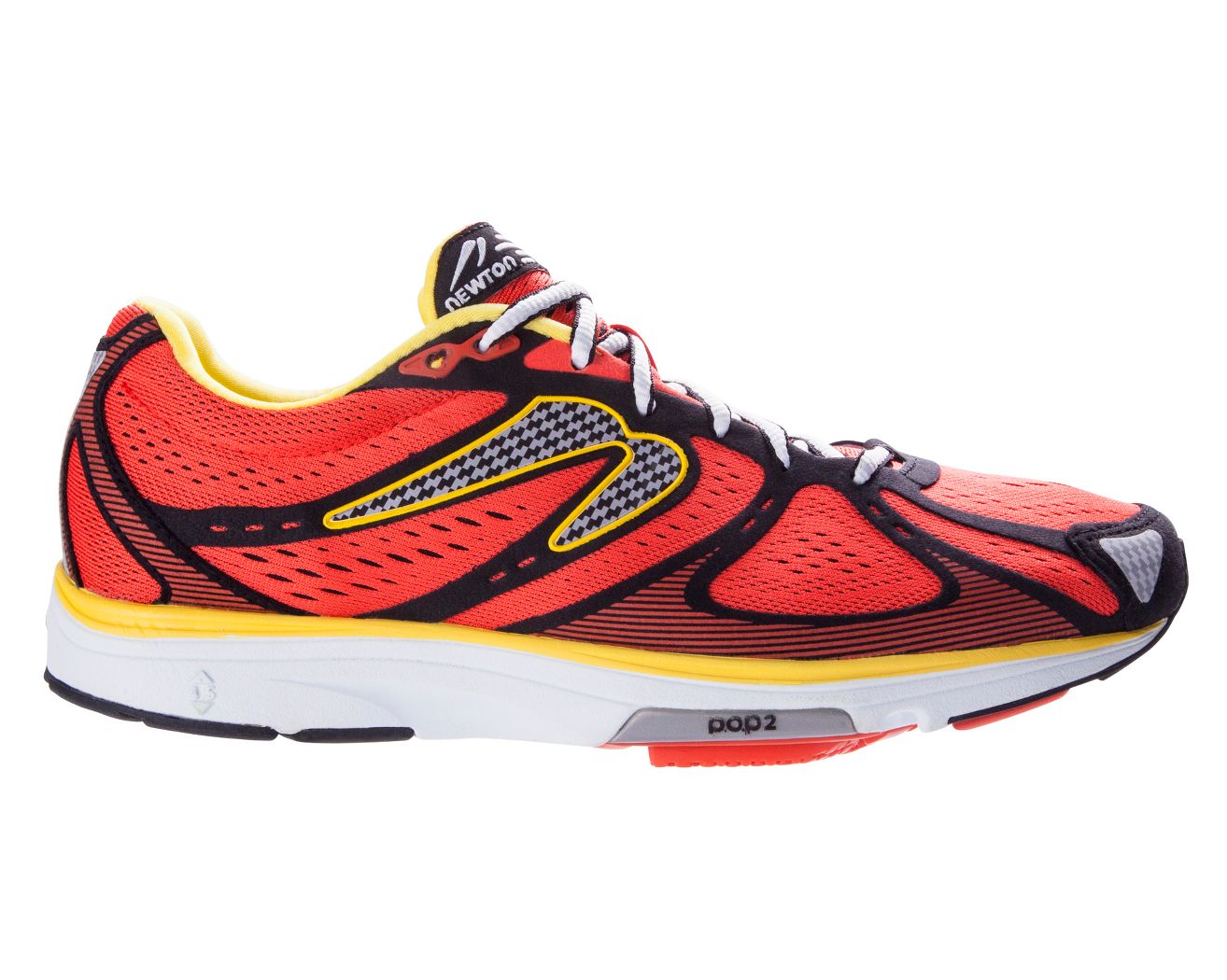
Gear Review: Newton Kismet

Newton Kismet in the color I've been testing. Image courtesy of Newton Running.
It's been almost a year since my last product review, which was the Skechers GoRun Speed. In the time since, I've had the unfortunate experience of #OopsIBrokeMySpine and the long road to recovery coming back.

As part of that recovery, it was also peak time for a new pair of shoes. My good friend Seth had opened up Granite City Running this past winter. As part of his opening, he had Newton Running come to the event with some demo pair of footwear. After chatting with their rep, as well as Seth talking up the Kismet, I decided to try a pair on.

I immediately knew that I was going to need to take a pair for a long-term test. I bought the orange pair that you see above in April from GCR and have been piling on the miles in it over the last two months.

The Tech Babble
The Kismet was a new model for Newton during 2014, as part of the year-long switch from the original four-lug platform to the new five-lug shoes. Part of this was due to advances in manufacturing tolerances; Newton had always wanted to be able to do five-lugs, but couldn't ensure the quality of the manufacturing to ensure the lugs would actually stay on the shoe when they were pushed out to the edges of the outsole.

In the image above, you have an old Newton Distance S; underneath, a Newton Tri Racer. As you can see, the five-lug pattern pushes out to the lateral edges of the midsole, whereas the old four-lug placement required a decent amount of offset from the edges.

The Kismet is part of the "P.O.P 2" family in the Newton line. Newton divides the line-up into the three distinct ranges:
  • P.O.P. 1: These are the classic shoes in the Newton family: the Gravity, Distance, and Motion ranges. They feature the lowest drops, most exposed lugs, and the classic Newton responsive ride.
  • P.O.P. 2: Referred to as the "Core" models, these shoes have a slightly higher drop than the P.O.P. 1 shoes. The lug pattern is also slightly less obtrusive, while also featuring slightly more cushioning than some of the P.O.P. 1 shoes.
  • P.O.P. 3: The most "traditional" of all Newtons, the lugs barely protrude from the outsole. These are designed to get people used to the feel of a Newton before transitioning into one of the other two families of shoes.
Now, I hear your question: why should I care about the lugs?

It's not so much the lugs that you should be worried about, it is the membrane that the compress into. This Action/Reaction membrane is compressed upon impact and then provides energy return. This is what gives Newton their snappy feel and has led to the claims from runners that they simply run faster in a pair of Newton's than anything else.

The Kismet is Newton's stability shoe in the P.O.P. 2 line. Newton takes a non-traditional approach to stability these days; rather than putting in a medial post to try to slow the rate of pronation, Newton fills out the shoe under the midfoot for maximum ground contact. This creates a more stable platform for the entirety of the foot to land on. Newton found during development that this approach provided a more stable and natural experience for runners with higher pronation rates.

The Kismet weighs in at 9.7 ounces in a size 9, with a 4.5 mm drop. Naturally, I have to take these published weights with the whole shaker of salt in my size 13 boats.

The Run
Running at Ragnar! Photo Credit to Kelly.

One of the primary things I noted when I slid my foot into the demo pair of Kismets back in December was what I didn't notice:

  • No annoying overlays in the wrong place.
  • No obtrusive feeling out of the lugs.
  • No feeling the shoe; it simply felt like an extension of my foot.
In other words: damn, this shoe feels like it fits my foot really, really well.

I've put about 200 miles on the shoe thus far and can say that, for the most part, those initial feelings continue to hold true. Unfortunately, the Newton logo attachment on the medial side, coupled with an overlay, tends to bunch up a little bit on the side of the foot over time; I've blistered a few times over in this spot.

That said, though, the ride of the shoe has been a revelation. I had a pair of the original Newton Motions, which I found the lugs to be overly obtrusive and the ride too harsh for long runs. Newton has finally found the feel balance: well cushioned yet responsive enough that you really feel the snappiness of the shoe when you pick up the pace.

A note: be prepared for the shoe to sound a little slappy, especially on some downhills. Don't be alarmed; it's just the AR membrane compressing in the heel. It took me a minute to figure out what the sound was, but it has not impacted overall performance of the shoe at all.

The beauty of this shoe is that it is light enough to race long distances in, while still retaining the cushioning and feel of an everyday trainer. It is an excellent swiss-army knife to add to your running arsenal, assuming that you need that touch of stability on offer here.

$129.00
Available Now


Saturday, September 6, 2014

Shoe Review: Skechers Performance Division GoMeb Speed 2

Editor's Note: I received this pair of shoes from Skechers Performance Division for the purposes of review. I was instructed to be honest. No financial considerations were offered nor would they ever be accepted.

I think I speak for a lot of people in terms of my initial reaction to Skechers launching a running shoe product line:

Skechers? REALLY? The folks who put out Shape Ups? Are you kidding me?

Yep. That was my initial attitude in the summer of 2012 as I saw the product line for the first time. I was seeded (read as: given a free pair of shoes; it is a common thing for a brand to do in the industry as hey, if you don't believe in it, you won't sell it) a pair of the GoRun Ride's.

And what do you know, they are actually pretty comfortable. Not great for me (a little too spongy underfoot, not quite moving with my foot) but a hell of a lot better than a lot of other things on the wall.

Fast forward to April of this year, and getting to see the big marketing push as Skechers segmented out the running shoe line in the new Skechers Performance Division at the Boston Marathon.

And then Meb won.

Then they signed Kara Goucher.

It was a sign of a brand that said, "We are committed to performance. We are committed to running." And now, starting in the spring, shoes will be exclusively committed to the specialty running channel. That's more than a lot of "traditional running brands" can say.

So with that in mind, I took a look at the product line, and asked if I could take the GoMeb Speed out for some testing. I figured it would be the ultimate test for the brand. At the end of the day, product is king. If your product sucks, it doesn't matter what elites are running in your shoes or how much you're trying to do for the industry. Your product better damn well be good.

The Tech Babble
Skechers Performance Division (think like the old Bowerman line in Nike running shoes; if it's not Skechers Performance Division or Bowerman in Nike-speak, odds are you're not looking at technical running product) started out introducing a line-up based on "M-Strike Technology." The "natural running" movement had really taken off, with the Saucony Kinvara, the Brooks PureProject, and New Balance Minimus product line really moving.

That being said, SPD took the tack of trying to offer more than just a "minimal" shoe. They would offer more of a range than simply going after the lightweight/minimal end of the market.

There are multiple shoes in the product line; this is their order from least to most cushioning: the GoMeb Speed, the GoRun Bionic, the GoRun, the GoRun Ride, and the GoRun Ultra. There will be more shoes launched throughout. They also range in offset from 0 to 8 millimeters.

The focus of this test, the Speed, features a 4 millimeter offset. This is similar to one of my favorite flats, the Saucony Fastwitch. The Speed features a mid foot shank of Hytrel, which gives the shoe some beef under the mid foot. A lot of times in racing shoes, the flexibility results in a shoe that gives up platform stability and efficiency. In theory, this is not the case here.

SPD, much like Pearl Izumi, does not use a "secondary" cushioning system like Air, Gel, or DNA. Instead, they rely on their blend of foam. In this case, SPD calls theirs Resalyte. Resalyte is an injection-molded compound, which according to SPD provides "memory retention [to] help absorb impacts." The beauty of foams, like the one SPD uses, is that each brand can spec different durometers, different air volume in the compound matrix, etc. that provides a unique ride.

The upper is seamless on the inner, with most overlays either printed or heat-molded onto the shoe. This in theory reduces the chances of blistering, as there are fewer places for the foot to really rub against a firm section on the interior. I wound up wearing the black-and-gold edition seen above.

The Speed weighs in at 6.8 ounces in a men's size 9. To put that in perspective, it's .9 ounces lighter than a comparable Saucony Kinvara. Versus my go-to flat, the Saucony Fastwitch, it is .1 ounces lighter. As an aside, the Speed ran large, and so I wore a 12.5. This will not give a true comparison on weight to a Fastwitch, as I wear a 13 in it, so I won't try to argue the merits. Besides, it's .1 ounces. I would never be able to tell the difference.

Enough Babble. How was the run?
In a word: brilliant.

I received these shoes on a Wednesday. That following weekend, I went down to Connecticut to tackle the Revolution at Rev3 Quassy, where I would be racing an Olympic on Saturday and a Half on Sunday.

I had made the decision that Saturday was my "race" day. My Fastwitch's were somewhere in my storage unit (I had just moved back from VA to ME), and I figured what better way to give a shoe a test than to slap 'em on and go racin'.

You put the shoe on and immediately notice...nothing. This is the best compliment you can give a shoe, in my opinion. The last thing you ever want to do when running is be worried about something on your feet. I slipped them on and just felt like the shoe and my foot were united in their job to propel me from Point A to Point B as quickly as my body could go.

Starting to stride, the shoe has a very snappy feel to it. You're going from impact to toe-off in a smooth, quick fashion. It wants to get up and play. That being said, it is incredibly well-cushioned. It felt as soft as some of my daily trainers in a much, much lighter package.

The mid foot shank works. As I started to fatigue, I could feel the shoe helping provide a stable platform for my foot to land on. It's secure and just lets you focus on turnover, breathing, and nutrition. In other words, again: you're not thinking about the shoe on your foot.

I crossed the finish line Saturday and faced a dilemma: the Speed felt so damn good, would I wear it again tomorrow on thrashed legs? For a half?

Answer: yes, yes I did.

And what do you know, it felt even better than the day before. The cushioning is incredible for a lightweight flat. It's the fastest I've ever run the half course at Quassy, and I can honestly say I ran every step of that run course for the first time. The shoe helped. It just let me go.

Would I wear this for a marathon? I was scheduled to find out the day that I broke my spine. I would guess that it would be close for me, personally, especially coming off the bike. But I can't honestly answer that question yet.

In sum, this shoe supplanted the Fastwitch as my go-to race flat. Of all of the things I'm looking forward to in my recovery, slapping these bad boys on for another race is towards the top of the list.

Skechers Performance Division GoMeb Speed 2
MSRP: $114.99
Available: Now

Monday, July 9, 2012

Shoe Review: Pearl Izumi isoTransition

I've been a bad, bad product reviewer.

Two months have passed since our last gear test around the CtB offices (the SwiftWick Aspire sock review). Far, far too long.

As a make-up, though, we'll be featuring at least a product review a week for the remainder of July. There's a lot to get through: Pearl Izumi Tri Fly Carbon IVs, blueseventy Helix wetsuit, Blue Triad EX,  XPS Baking Company X-Series Cookies, as well as this review here.

So, let's get down to business, shall we?

Men's Pearl Izumi isoTransition
The Tech Babble
The first thing that generally comes to mind when you think "Pearl Izumi" is cycling, and for good reason: together with parent company Shimano, PI covers 85% of the market. To put that in perspective, the current leader in the running footwear business (Brooks) has a market share of 18%. It's a staggering number!

To no surprise, as triathlon took off Pearl Izumi went headfirst into it, creating numerous apparel and cycling shoe options. And options they have: three different product lines for apparel, three distinct options on the cycling shoe front.

However, PI's running shoes have always left something to be desired. My first experience with PI's running product line came in the form of the original SyncroSeek trail shoe. It's a shoe that makes my top 5 list of worst running shoes ever: heavy as a brick, ran a full size and a half small, and had absolutely no arch in it to speak of. It felt like PI had decided to take one of their mountain biking shoes, slapped a midsole and outsole on it, and called it good.

Not a good first impression. Hello, blacklist.

Thankfully, PI learned from these mistakes. The isoTransition still runs a little short on length, but there is an arch on the inside of the shoe, thanks to the OrthoLite insole. OrthoLite was once used by Nike and Saucony, respectively, for their insoles to their running product line.

The overall theme to the PI product line is what they call 1:1. This is, in their terms, trying to make the athlete and gear one and the same; a mating of the two that is completely natural. PI's big technology hallmark, at least for this particular shoe, is their seamless upper. There are no interior seams anywhere on the shoe. Less seams, of course, should mean less blistering, as there are fewer friction points on the interior of the shoe.

Cushioning comes from a midsole constructed solely from PI's proprietary blend of EVA. No gel pods, no Syncro cradles, no nothing extra. This is a "I'll take my meat and potatoes, thank you very much, nothing else" shoe. Don't take that as meaning that it's under-cushioned; it's just that the shoe is extremely reliant on the ability of the foam to handle the task at hand. Midsole stack heights are 19 millimeters in the heel, 10 millimeters in the forefoot, for an offset of 9 millimeters.

Drainage holes are cut through the bottom of the shoe; this has an unintended consequence which we'll get to during the running section. To complete the shoe, there is an integrated bootie tongue and elastic laces. Total weight for the shoe in a men's size 9 is 7.8 ounces; of course, my size 13 boats weigh in slightly heavier.

The Run
Well, congratulations, Pearl Izumi: you're off my blacklist.

Popping these on, the first thing you notice is, much like the K-Swiss Kwicky Blade Light, is what's not there, rather than what is: there's no impinging seams. There's no pressure points. Instead, you have a shoe that hugs around the foot before opening into a wider toebox to promote forefoot splay. It's comfortable in the same way that, say, walking around in a slide sandal is comfortable: there's only one piece really holding onto your foot, and then the rest of your foot may do as it pleases.

The isoTransition is a neutral shoe, which usually would be bad news for this esteemed author. However, there's some natural stability built in here. Some of that comes from the lowered offset and the natural splay of the forefoot (the wider your toes may spread, the larger the "tripod" your foot can become and be naturally stable). But it also comes from a relatively rigid midfoot region. A small bridge exists only on the medial side of the shoe, giving it additional structure here. It's just enough to allow me to run in it without any type of additional support. I think the best corollary might be some of your structured neutral shoes, a la Asics Nimbus: even though it's neutral, there's just a touch of stability available to those who need it.

There's some serious cushioning underfoot, especially for something with only 10 millimeters of cushioning in the forefoot. The foam has some bounce to it; I'm guessing there's a bit more rubber in the blend of EVA that Pearl Izumi engineered. But the energy return does not come at the cost of pure protection from the road. This is, in my opinion, the result of the drainage holes cut underfoot: it allows the shoe a little bit more room to spread out upon impact, dispersing energy away from the foot.

These holes also make the shoe incredibly flexible in the forefoot. This is good for someone like myself, who has an inherent lack of flexibility in my big toe: I have a hard time with shoes that are very stiff in the forefoot and getting them to respond in sync with my foot. This, on the other hand, is very easy to pick up and go.

Varying stride lengths, it seems like this is a shoe that wants a pretty high cadence. Unsurprising, given some of the athlete's that Pearl Izumi has on the roster: Tim DeBoom and Cait Snow both run with very, very high cadences. Quick turnover really makes this shoe come alive with it's mix of cushioning and energy return.

I have yet to test the drainage on the shoe, as I haven't raced in them yet and that's generally the only time you'll see me dumping gallons of water over my head. But I believe it's safe to say that it will be pretty effective, given that there is drainage from heel to toe.

Overall, it's a great riding shoe for those who like a bit more of a responsive feel underfoot, but don't want to be penalized for doing so. It's a nice mix of road feel, isolation, and fit.

It's more than a triathlon shoe: it's a great running shoe.